Can It Stop a Pine Needle?
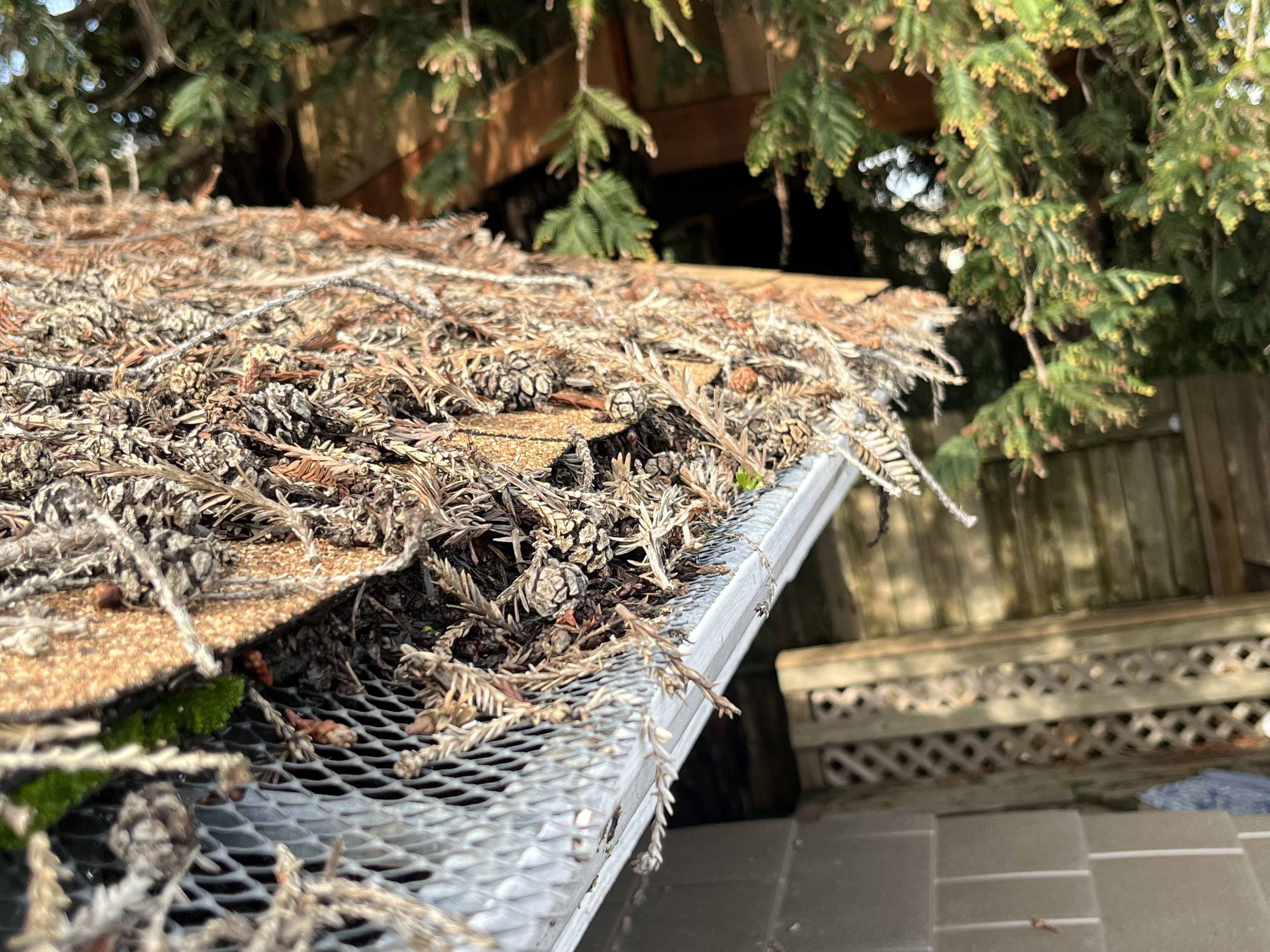
Every guard has openings. The size of those openings is the single specification that determines what the guard can and cannot stop.
What falls on your roof has physical dimensions. Pine needles, oak flowers, seed pods, maple samaras, roof-shingle granules — each has a minimum dimension, the smallest axis along which it could pass through an opening. If the guard's openings are smaller than that dimension, debris stays on top. If the openings are larger, debris enters the gutter.
The complication is what happens at the threshold. A pine needle slightly thicker than an opening pokes partway through, catches on the mesh, and becomes an anchor. The next needle drifts against the first and catches too. Within two or three seasons, what looked like a protective surface is a thicket — with the original debris slowly decomposing at the exact line where water should flow through. This anchor-and-stack mechanic is one of the quiet reasons mid-generation guards with moderate opening sizes fail years earlier than their specifications suggest.
Micro-mesh at opening sizes measured in fractions of a millimeter closes the door on this entire category of failure. Every piece of organic debris — needles, flowers, seed pods, even roof-shingle granules — stays on top. Debris lands on top and sits there, where wind and gravity get their chance to clear it. What's below the mesh stays clean.
The first thing I check against any guard is the opening size relative to the debris falling on that specific roofline. The smallest thing consistently landing on your roof — pine needle, oak flower, whatever dominates — either fits through the openings or catches on them. That's a hard measurement, and it's in your report.
Metal Against Metal.
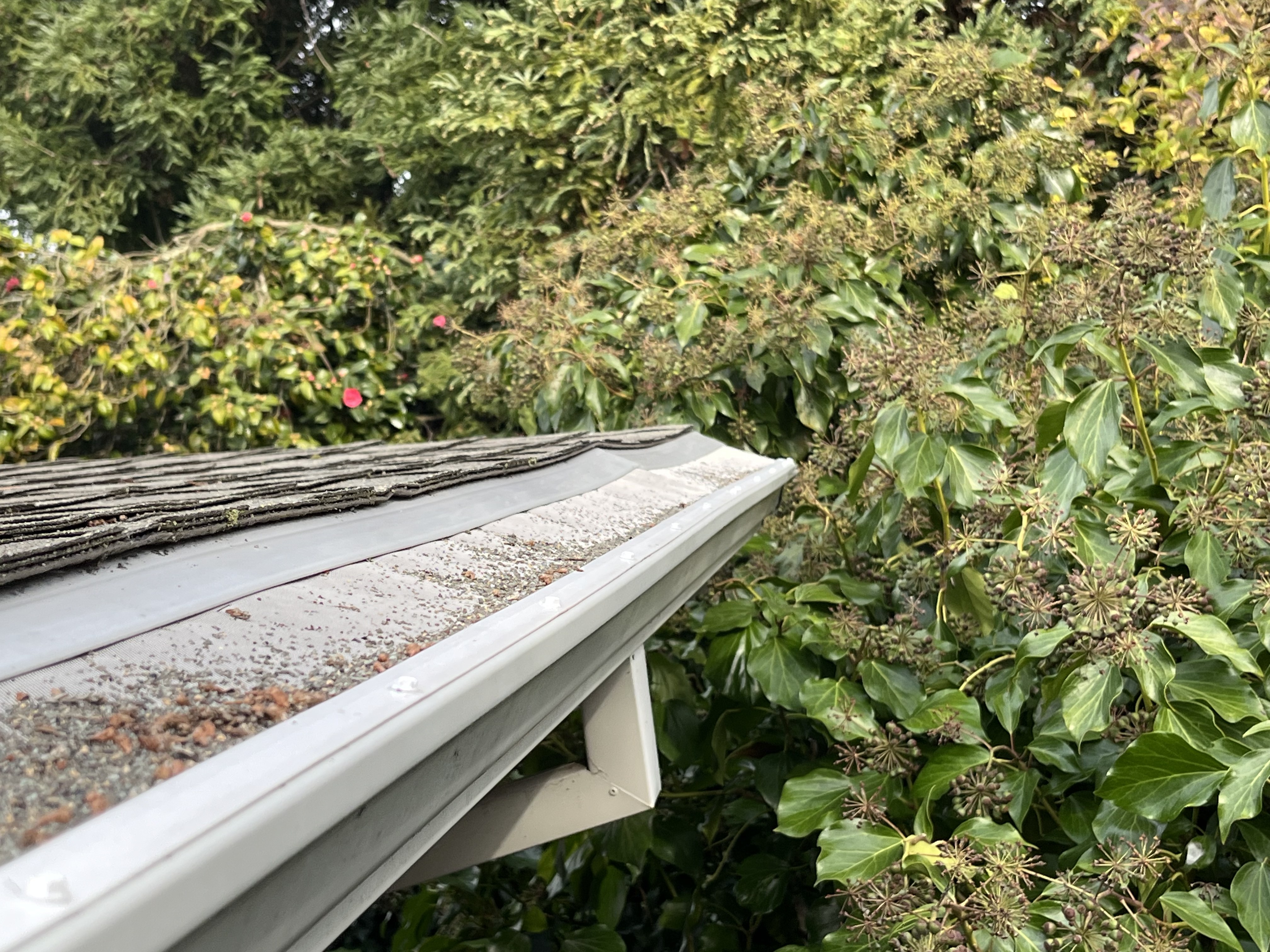
Your gutter is almost certainly aluminum. The guard on top can be aluminum, galvanized steel, coated steel, stainless steel, or a plastic panel. Each has a different lifespan and a different relationship with the rest of the system.
The current high end of the category is 316 surgical-grade stainless steel. Its composition — iron, chromium, nickel, and molybdenum — is the same alloy specified in marine hardware, where ordinary stainless pits and corrodes. The molybdenum is the difference-maker. Applied to a gutter guard, it produces a surface that resists the slow chemistry of rainwater, pollen, oak-leaf acids, and oxidation for years longer than standard alloys.
316 stainless stays smooth without a coating. Coatings are used on lower-grade metals to compensate for corrosion — powder coat on aluminum, painted finish on galvanized steel. Coatings have a lifespan. UV, thermal cycling, and mechanical contact all erode them. What you own at year fifteen is not the coating. It's the substrate beneath. Uncoated stainless stays consistent: year one and year fifteen are materially the same surface.
The other half of the materials question is the contact zone — the line where the guard physically touches the gutter lip. Any two dissimilar metals in contact, with rainwater as an electrolyte, slowly exchange material through galvanic corrosion. Stainless-to-aluminum is a mild, slow pairing. Coated-steel-to-aluminum, once the coating wears through, becomes considerably faster. Standing water at the contact zone accelerates every version of this.
The materials question has enough depth that I wrote a companion piece on it: The Gutter Guard Question Nobody Asks.
Through the Mesh — or Off the Edge.
Water has two paths through any gutter guard: laterally across the surface, or vertically through it. The design determines which path — and how much rainfall the design can handle before the path breaks down.
The category's ability to move water has evolved dramatically. Each generation raised the rainfall ceiling:
That headroom matters more than the number suggests. A cloudburst during a NorCal atmospheric-river event can briefly deliver two to three inches per hour. A guard rated at seven inches per hour is inside its envelope by a factor of two or three — and as surface debris, pollen, and oxidation gradually reduce effective flow over years, that margin shrinks. A guard rated at twenty-six inches per hour has ten-plus times the headroom from day one, and remains well inside its envelope after years of surface aging.
The three design families handle water passage differently:
Surface-tension / reverse-curve / solid-hood designs rely on water clinging to a downward curve and bending around it into a narrow slot. They perform well at moderate rainfall. When rainfall exceeds the adhesion force holding water to the curve, the water launches off the front edge and skips the gutter — the gutter stays dry while the soil at your foundation is saturated.
Screen / louvered panels use openings measured in fractions of an inch. They handle water well because the openings are large. They handle debris poorly for the same reason — anything smaller than the holes passes through into the gutter.
Micro-mesh / wick-down designs route water vertically through fine mesh. Rain hits the mesh and passes straight down into the gutter. At top-tier mesh density and rainfall ratings, this is the design that handles cloudburst scenarios surface-tension designs cannot.
The wick-down advantage extends to what sits on top. Even when surface debris is present — a stacked mat of redwood needles, pine needles that didn't blow off, a layer of decomposing oak leaves — water continues passing vertically through the mesh underneath, below the debris, into the gutter. The water travels through the mesh; the mat sits on top, the flow stays below.
One further consequence: a guard that keeps water moving through — instead of pooling on a surface or in a partially clogged trough — does not create standing water. No standing water means no mosquito breeding habitat. A public-health footnote on a drainage specification, but a real one in NorCal summers where any standing water near a home is both a nuisance and a West Nile vector concern.
Does Debris Fall Off — Or Stack on Top?
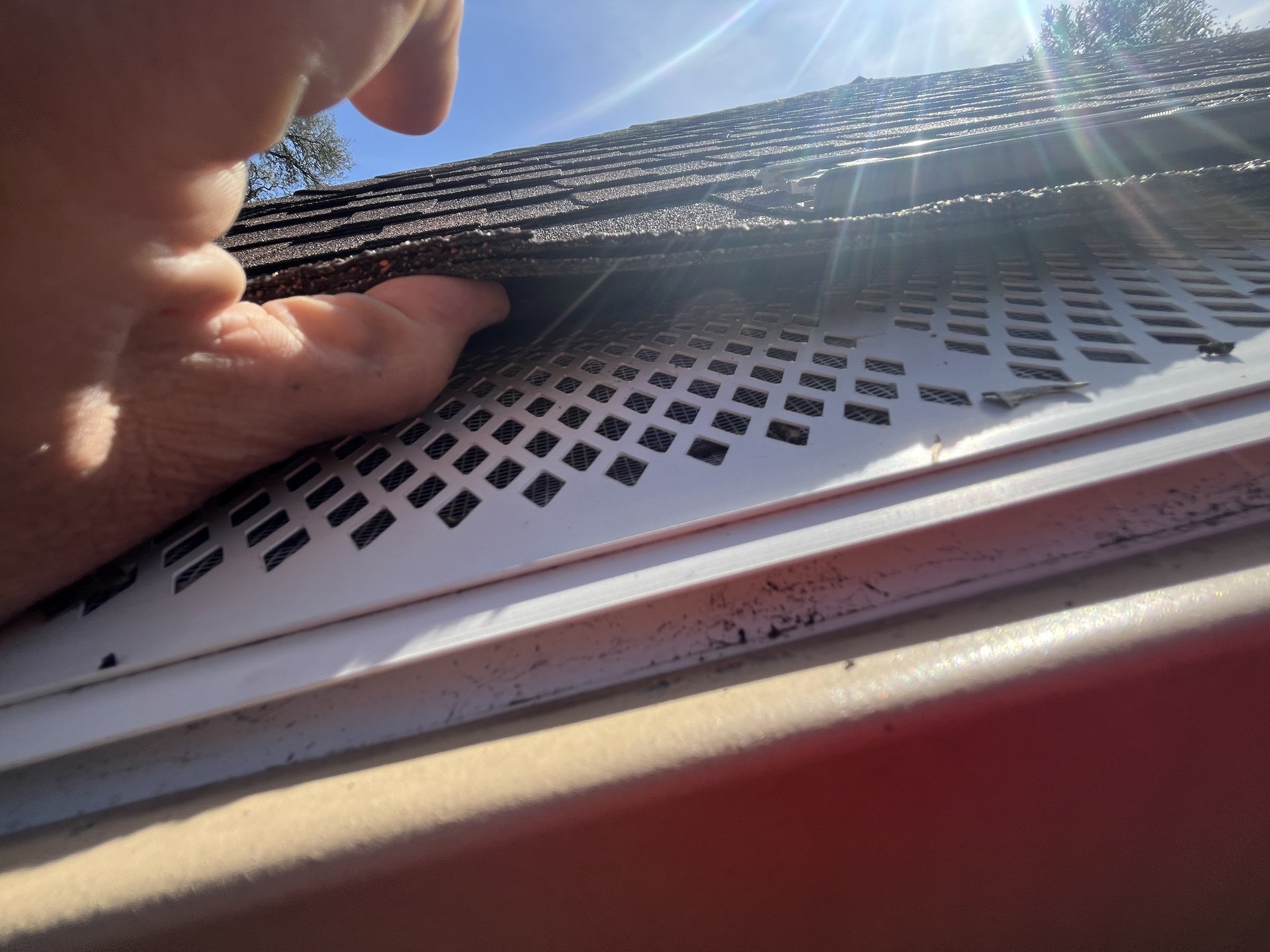
Every piece of debris that lands on your roof arrives with momentum. Gravity carries it down the pitch. Wind pushes it laterally. When it reaches the gutter line, one of two things happens: it continues past the edge and falls to the ground, or it stops and stays.
What determines the outcome is the friction coefficient of the guard surface relative to the roof above it. Asphalt shingle — the material on most NorCal roofs — has a textured, granulated surface. It's intentionally rough. That's the surface delivering debris to your gutter edge.
If the guard at the bottom of the slide is smoother than the shingle, debris encounters less friction at the guard than on the roof. Its momentum carries it across the guard and off the front edge. The guard participates in the roof's natural self-cleaning.
If the guard is rougher than the shingle — textured, coated, or profiled with raised elements — debris encounters more friction at the guard than on the roof above. Momentum fails. Debris stops. Over seasons, more debris arrives, catches on the first, and compacts into the kind of organic mat that sits on top of the guard until someone climbs a ladder to clear it.
Uncoated 316 surgical-grade stainless steel is the current category benchmark here. Its surface is naturally smoother than asphalt shingle. Year fifteen is materially the same surface as year one. Debris that was sliding off the roof continues sliding off the guard.
Coated guards can start in the same friction range, sometimes even smoother at installation thanks to the coating itself. But the coating wears. UV, thermal cycling, acidic rainwater, organic contact — all slowly increase the surface roughness. The friction equation gradually shifts. What was a self-shedding surface at year two becomes a debris-catching surface at year ten, and an organic-mat-accumulating surface at year fifteen.
A guard's friction relative to the roof above it determines whether debris stays or goes — and whether that relationship holds or drifts depends on whether the guard has a coating that will eventually wear off.
Two Numbers Decide Whether a Guard Fits.
Two specifications on your house decide whether any given guard will function correctly. Both are facts about your roof.
Your roof pitch. The angle at which your roof sheds water. Lower-pitch roofs slow water down; higher-pitch roofs speed it up. Some guard designs have a published minimum pitch below which the physics break down — water pools where it shouldn't, or surface-tension designs lose the velocity needed to bend around their curve. A contractor, a roofer, or a phone app with a level function can give you the number in two minutes.
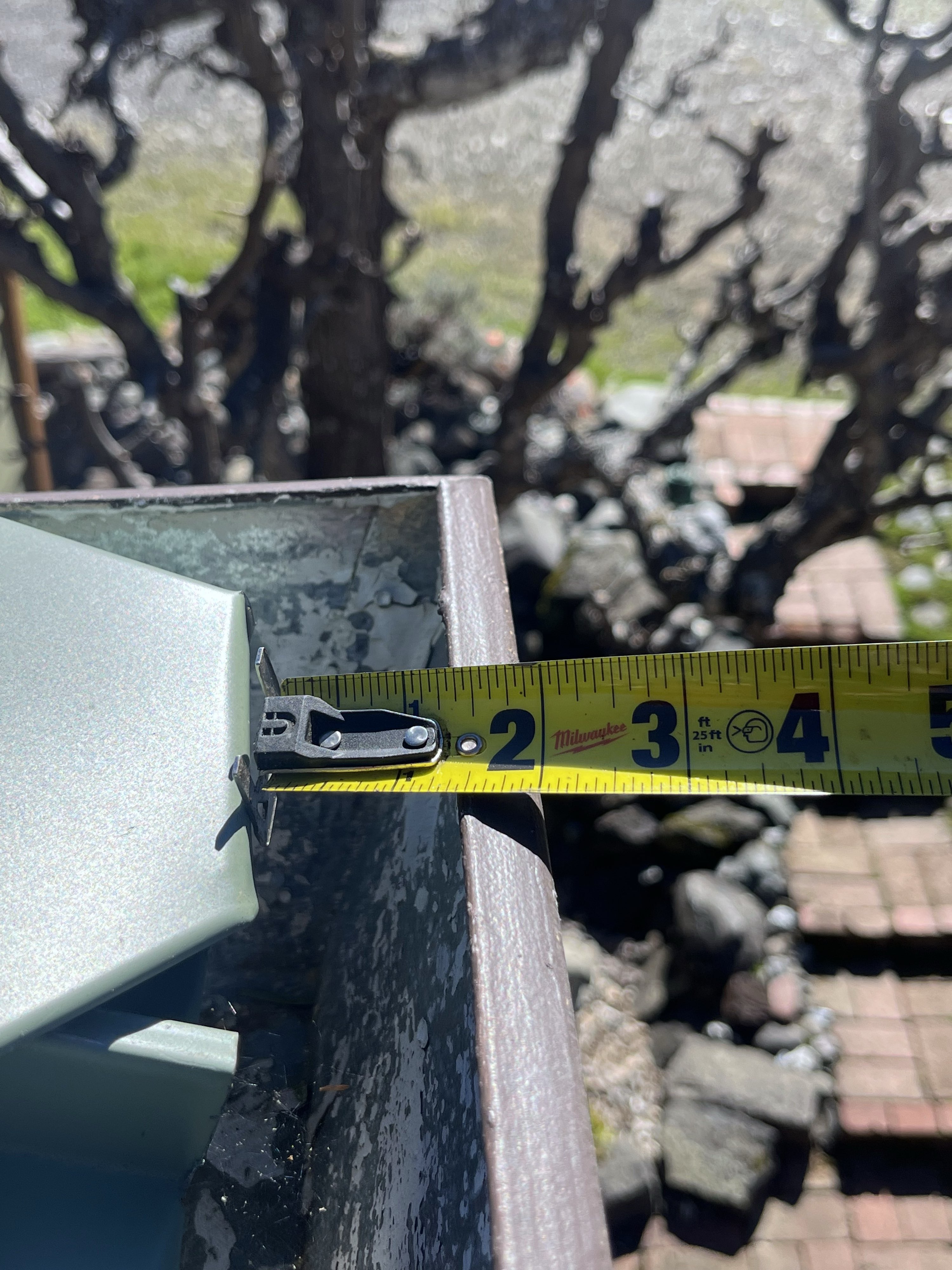
Your gutter profile. The shape and dimension of your existing trough. Standard 5-inch K-style is the assumption built into most consumer guard products. A lot of NorCal homes don't have that. Six-inch oversized gutters, half-round gutters, fascia-style integrated gutters, and the narrow 3- and 4-inch gutters on older homes all behave differently. A standard panel sized for 5-inch K-style may bridge across the top without touching the interior walls, block part of the trough, or sit proud above the roofline. None of that is visible from the driveway once installed.
Measure the interior width of your gutter at multiple points along the run — some homes have different profiles on different elevations. Measure the roof pitch. Both numbers are facts about your house that exist before any product enters the conversation. A guard designed for your specific pitch and profile performs differently than a standard consumer panel, and the difference shows up several storms in.
Interior gutter width at several points along the run — different elevations can carry different profiles. Roof pitch with a level. Both numbers go into your report before any product is mentioned.
What "Lifetime" Actually Covers.
The word "lifetime" appears on most gutter-guard warranties. As a marketing term, it's effective. As a contract term, it requires definition.
Four structural questions define what any warranty actually covers:
What voids it. The exclusion list is where the real warranty lives. Common voiders include: anyone other than the installer physically contacting the guard; roof work performed by third parties; failure to maintain the guard's top surface; storm damage above a stated threshold; and "acts of God," a clause whose scope varies widely by document.
Whether it transfers. If you sell in eight years, does the warranty move to the next owner? Transferable at no cost, transferable with a fee, or terminates on sale — these are three different products.
What's covered. The guard itself is almost always covered. The installation labor to remove and replace it is sometimes covered. The downstream damage from a guard failure — rotted fascia, stained siding, foundation moisture, interior water intrusion — is almost never covered. That gap is significant, because the downstream damage is typically the expensive outcome.
How claims resolve. A phone number to a local office, a corporate claims department, an online portal, or a third-party administrator. The structure of the process predicts the reality of getting a problem addressed in year nine.
A warranty read before installation is a contract. A warranty read for the first time during a problem is a surprise. The document is worth sitting with for ten minutes on the front end.
Before the Guard Goes On.
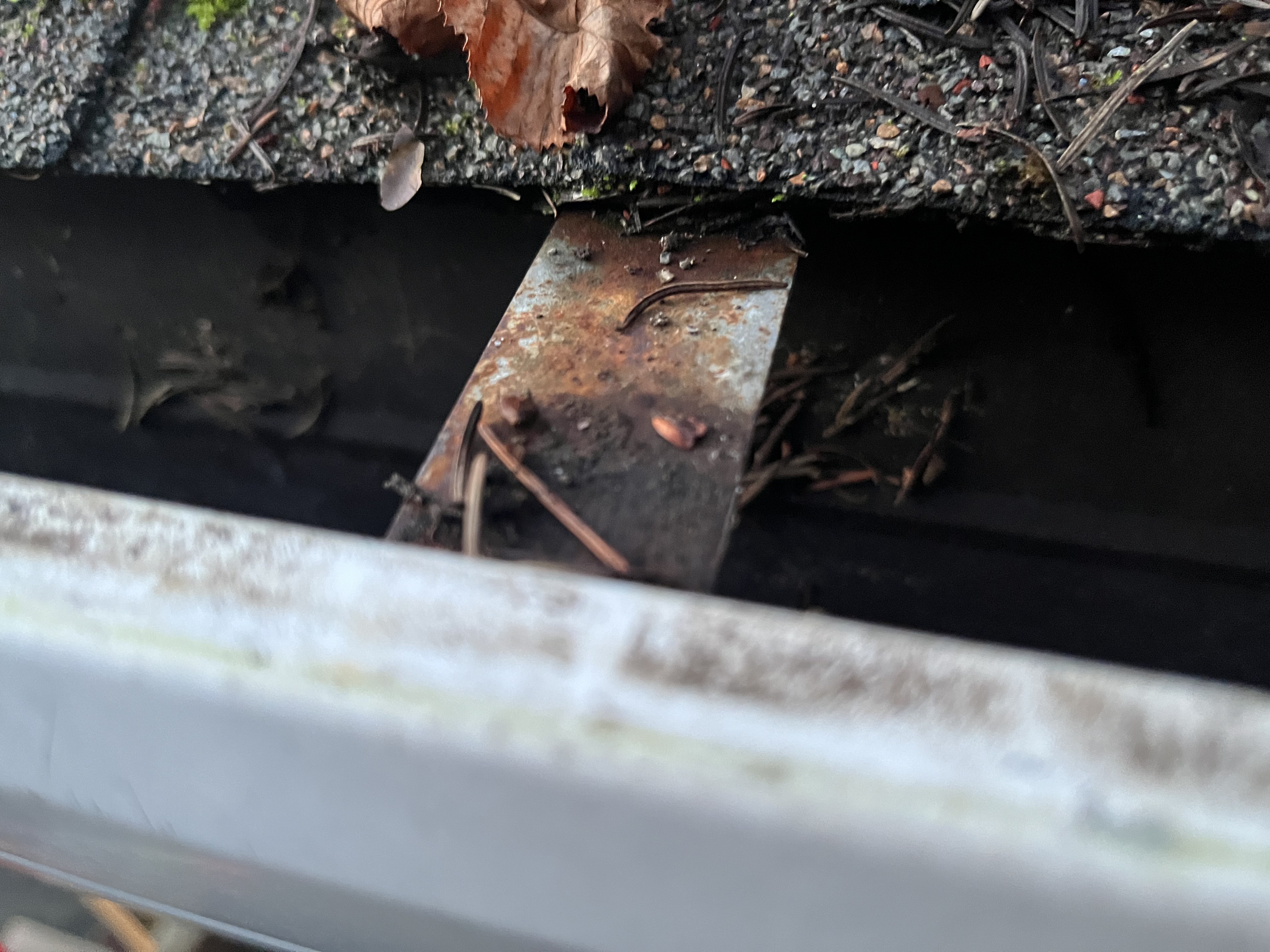
A guard's performance over decades is determined as much by what's beneath it as by what it is.
A proper installation is a sequence. Before any guard is placed, the gutter system beneath has to be prepared. The sequence that defines a quality install:
Cleaning the trough completely. Any debris left in place is now sealed inside, where water contact continues and air flow decreases. Biological decomposition accelerates. Sealing debris under a guard accelerates every problem already in progress.
Inspecting every seam. Gutter seams are the most common leak point. A seam that was borderline-sealed before the guard will not self-heal underneath one. Trapped condensation and slowed evaporation make seam failures progress faster.
Verifying gutter pitch. A gutter should drop roughly a quarter inch per ten feet of run toward its downspout. Incorrect pitch pools water in the low spots. Under a guard, that pooling becomes invisible, and the evaporation cycle that would slowly clear an open gutter is suppressed. The trough stays wet.
Replacing failing hangers. A hanger pulling away from the fascia is a loose gutter waiting to happen. Every worn hanger gets replaced before the guard goes on.
Checking the fascia board. If the wood behind the gutter is compromised — soft, rotted, delaminated — no new fastener will hold for long. A responsible installer stops at this point, shows the condition, and discusses whether fascia repair should happen before any new system goes on. Skipping this step is how a warranty claim gets denied in year four: the underlying wood failure was never addressed.
A guard is only as good as the gutter system it sits on. The installation sequence is where that foundation either gets built — or gets hidden.
Who Returns When a Panel Lifts.
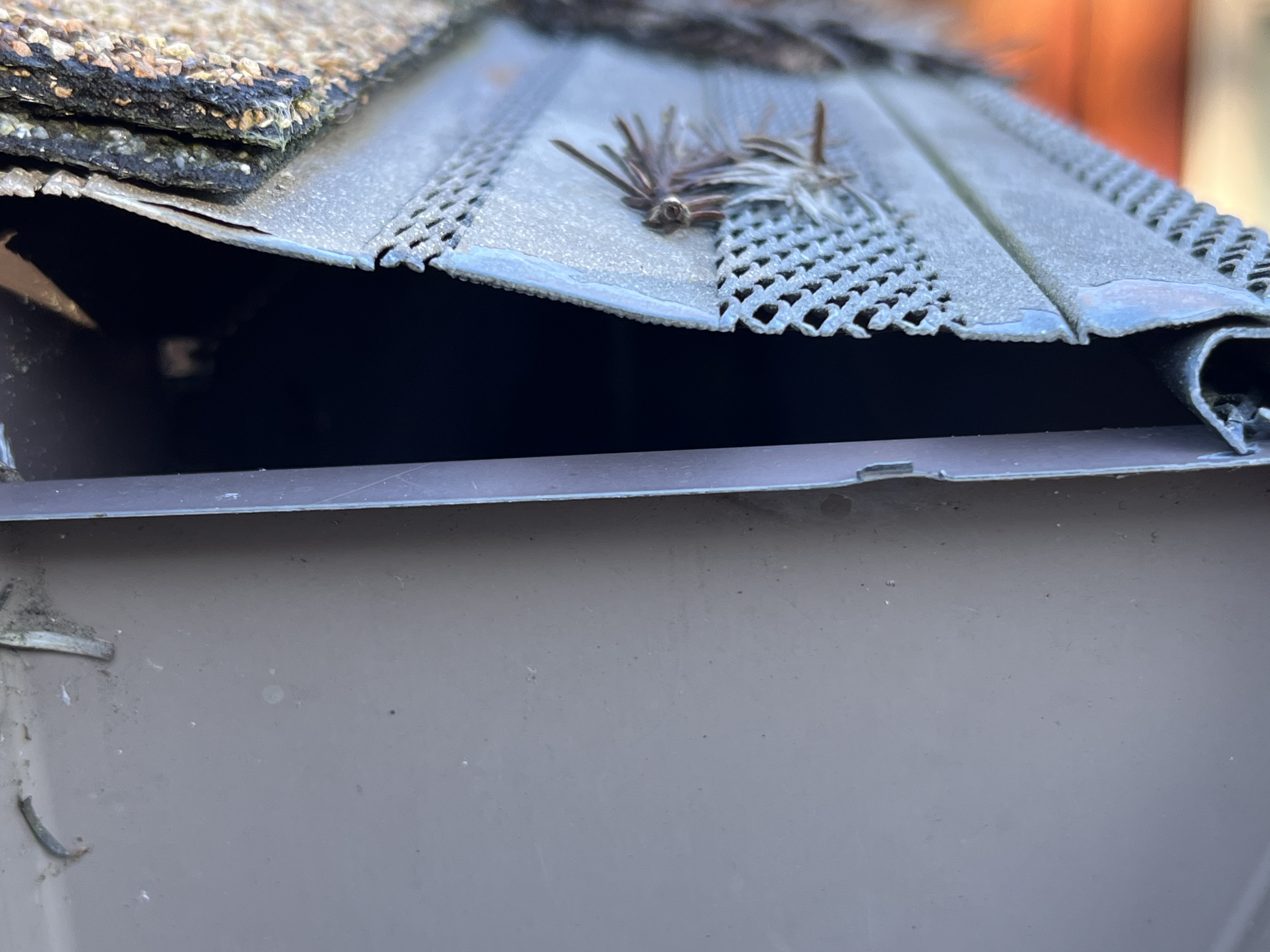
In year six, after a winter windstorm, a single panel lifts on the northeast corner of your house. You see it from the driveway. What happens next depends less on the product and more on the service infrastructure around it.
A gutter-guard relationship spans decades. Across those decades, a homeowner may need a warranty claim processed, a panel reseated, a hanger replaced after a storm, or a transfer of coverage when the property changes hands. Each depends on whether a crew can get to your house when it's time.
Service models in the gutter-guard industry vary:
Local companies with their own crews based within an hour of home typically respond within days. The crew that installed the guard is often the crew that returns.
Regional franchise or dealer networks operate crews serving wider territories. Response time extends to weeks.
National brands with dispatched subcontractors may have longer chains between your phone call and a ladder against your house. The warranty is with the brand. The work is contracted to whichever crew the brand partners with in your zip code at that time.
All three models can work. What matters is whether the model matches your expectations for service proximity — and whether the proximity holds across the years the warranty claims to cover.
Three questions, answered with specifics, tell you what the service infrastructure actually is:
Where is the nearest service crew physically based? An address or a city, not a marketing region. Where a product is purchased and where the service crew is dispatched from are not always the same location, and the distance between them is worth knowing before it matters.
What is the typical response time for a service call? Days or weeks, with a range — actual time from call to site visit.
What is the path for service calls outside warranty coverage? Some year-eight issues fall outside warranty coverage. Knowing the structure of a paid service call in advance is easier than discovering it mid-problem.
Product quality, installation quality, and warranty structure all matter. Service infrastructure is what converts those three into decades of actual performance.