The Disappearing Act
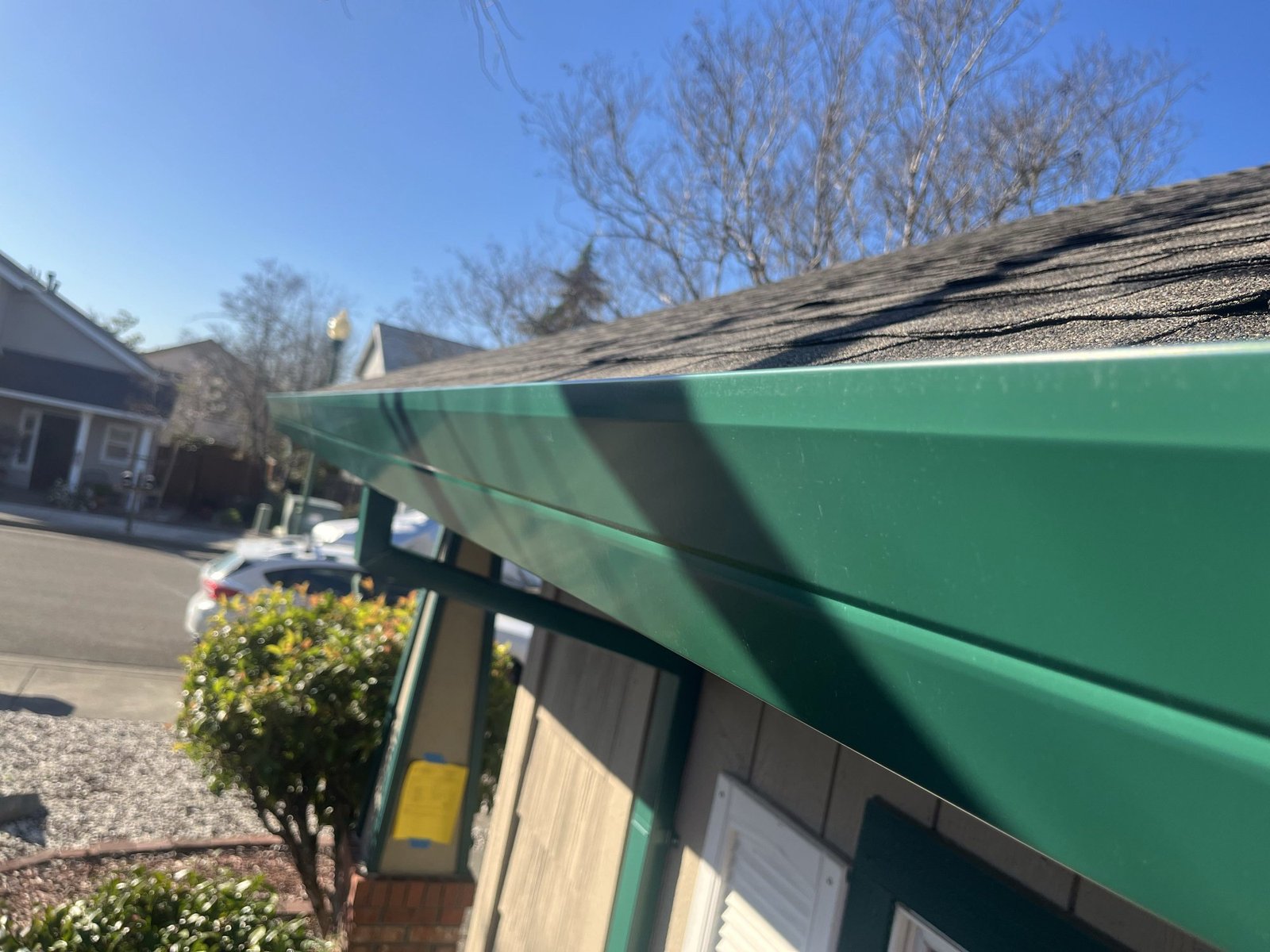
Your gutters were engineered to be invisible.
Consider that for a moment. The system responsible for moving every drop of rain off your roof and away from your foundation was specifically designed so you'd never have to look at it. It tucks under the roofline. It matches your fascia color. It drains before you notice it's full. On a dry afternoon, your gutters are the least interesting thing on your house.
That invisibility is the first reason they fail.
Every other system on your home announces when something is wrong. Your HVAC groans. Your plumbing drips. Your windows fog. Your gutters just quietly fill up, overflow into the wrong places, separate at the seams, sag toward the middle, and rot the wood behind them — all while you're inside making dinner, or backing out of the driveway, or standing on the porch in the rain thinking: that's a lot of water.
It is a lot of water. On a modest NorCal home with 1,800 square feet of roof, a single inch of rain moves roughly 1,100 gallons off that surface. Your gutters collect it, route it, and deliver it somewhere sensible. When one part of that system fails — just one — those 1,100 gallons go somewhere else. Quietly. Every storm.
From the Driveway
Stand in your driveway and look up at your gutters.
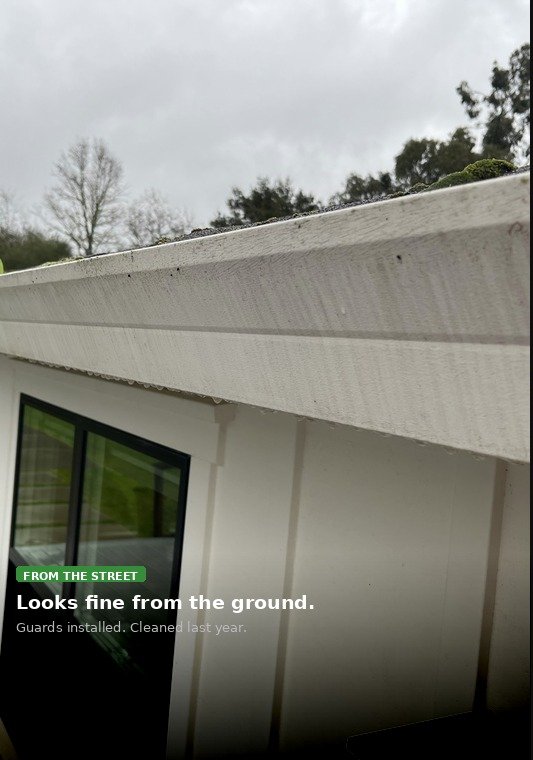
They look fine.
Of course they do. You're looking at the outside edge of an aluminum trough from fifteen feet below. Paint. A straight line. Maybe some algae streaking, but nothing that says call someone.
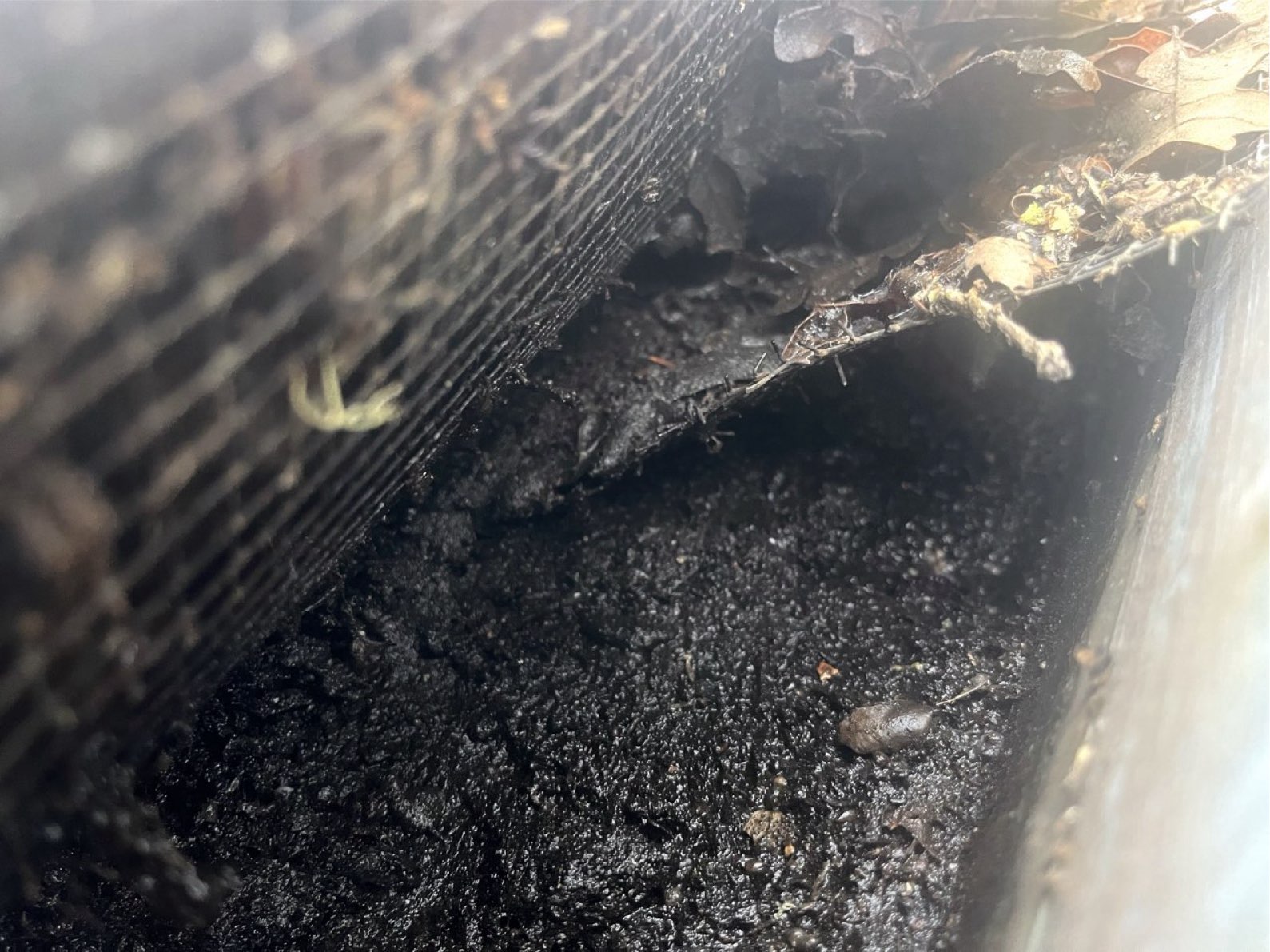
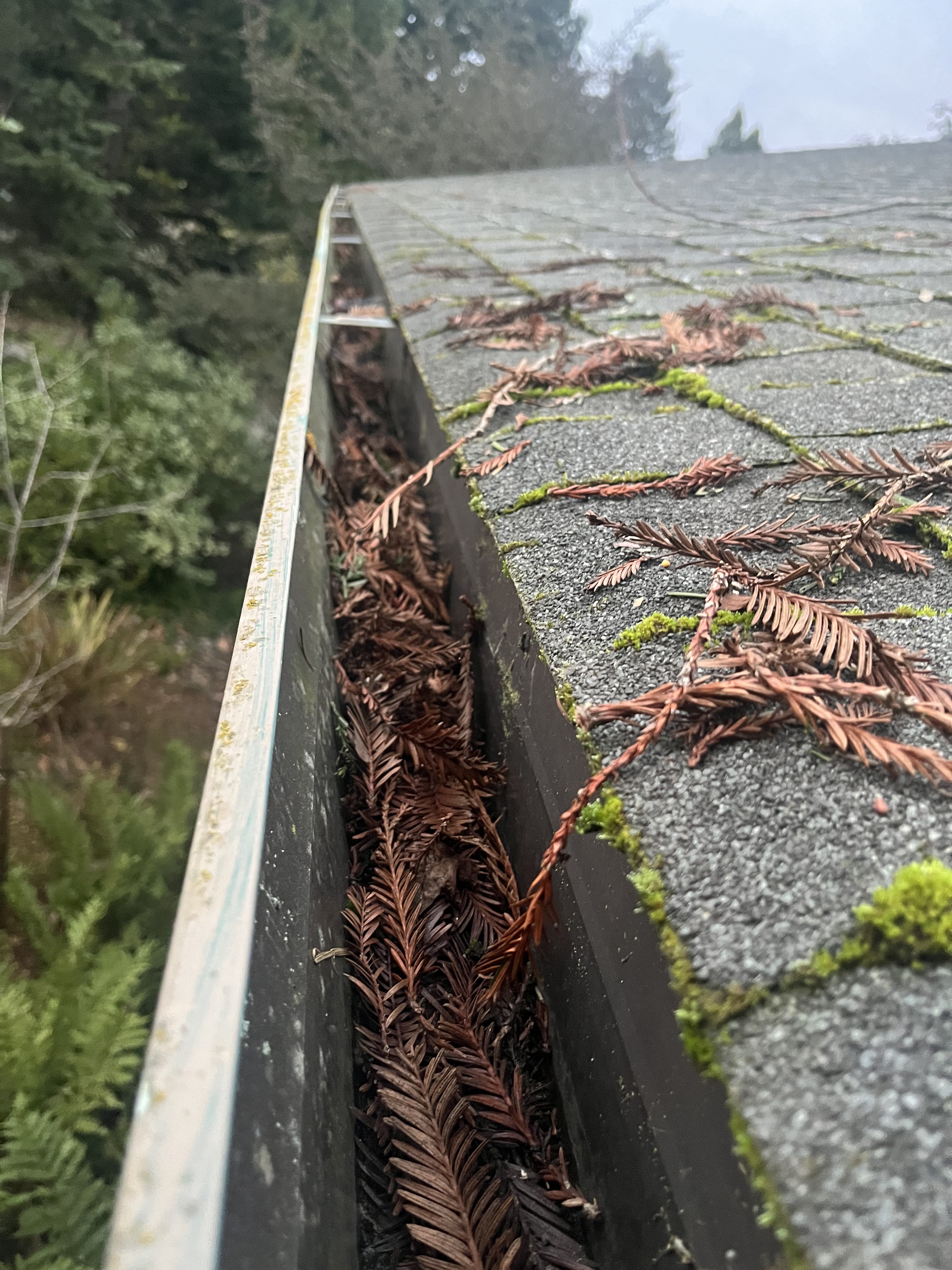
What accumulates in a gutter that hasn't been properly cleaned in several seasons is not a pile of leaves. Leaves decompose. Give them two seasons and they become something different: a dark, heavy, soil-like material pressed flat against the gutter floor, wet in the middle and baked dry on top, dense enough that it won't flush out with a garden hose. It has weight. It has chemistry. And it's been sitting against the bottom of your gutter long enough to start working on the metal.
The driveway view tells you the shape of the gutter. It tells you nothing about what's living inside it.
The Guard You Trusted
You spent money. You did the research. You watched the videos. You paid a crew to install guards — mesh ones, foam ones, reverse-curve ones that promised to let water in and keep everything else out. First year, maybe two, they seemed to work. You crossed it off the list.
Gutter guards do not eliminate the need to maintain gutters. Most of them defer it. Some make it harder.
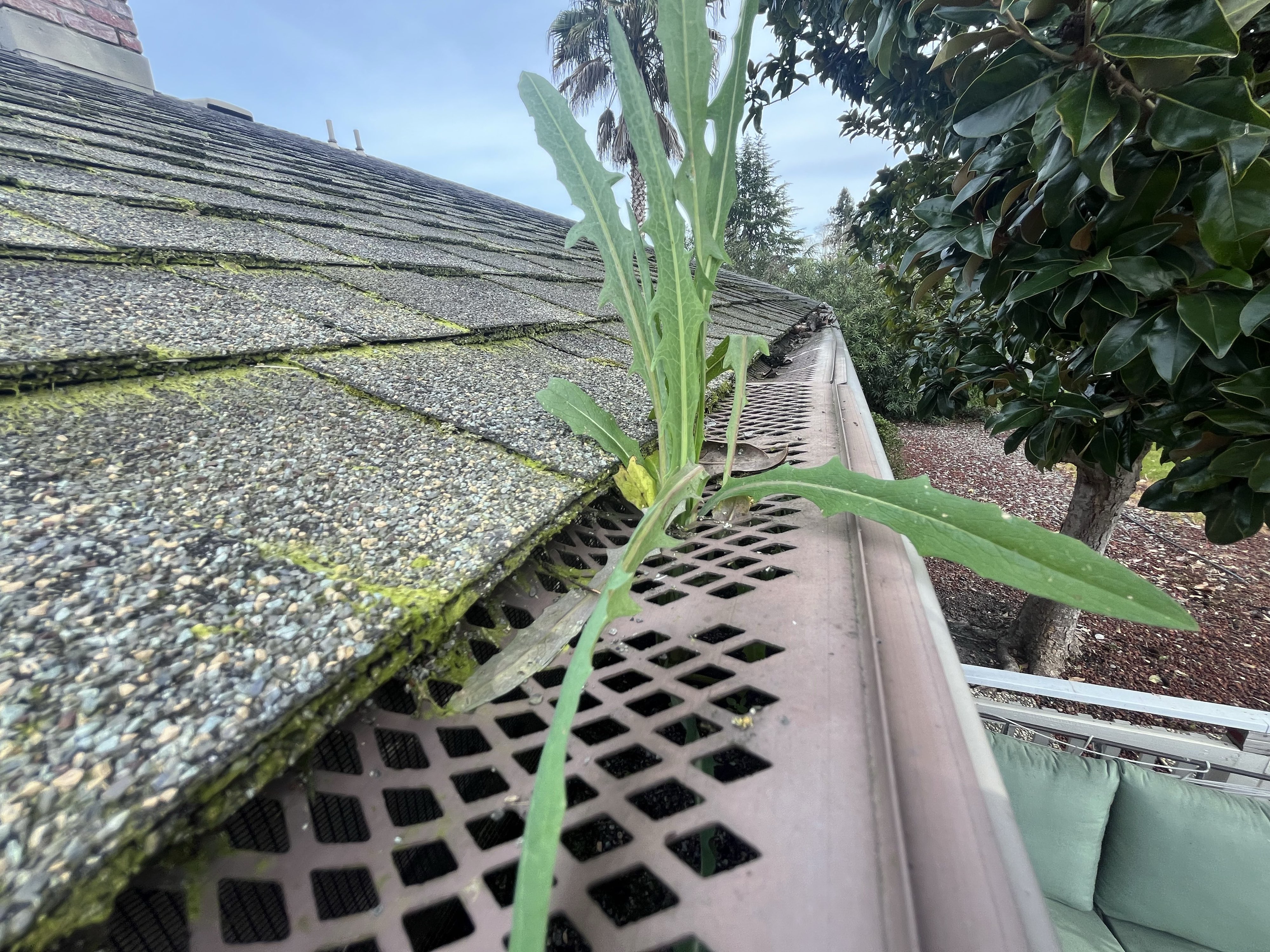
The fine mesh that keeps out leaves does nothing about the shingle granules, seed pods, pollen, and microscopic debris that washes off your roof with every rain. That material passes through the mesh, settles to the bottom, and builds up in a way that's invisible because the guard is covering it.
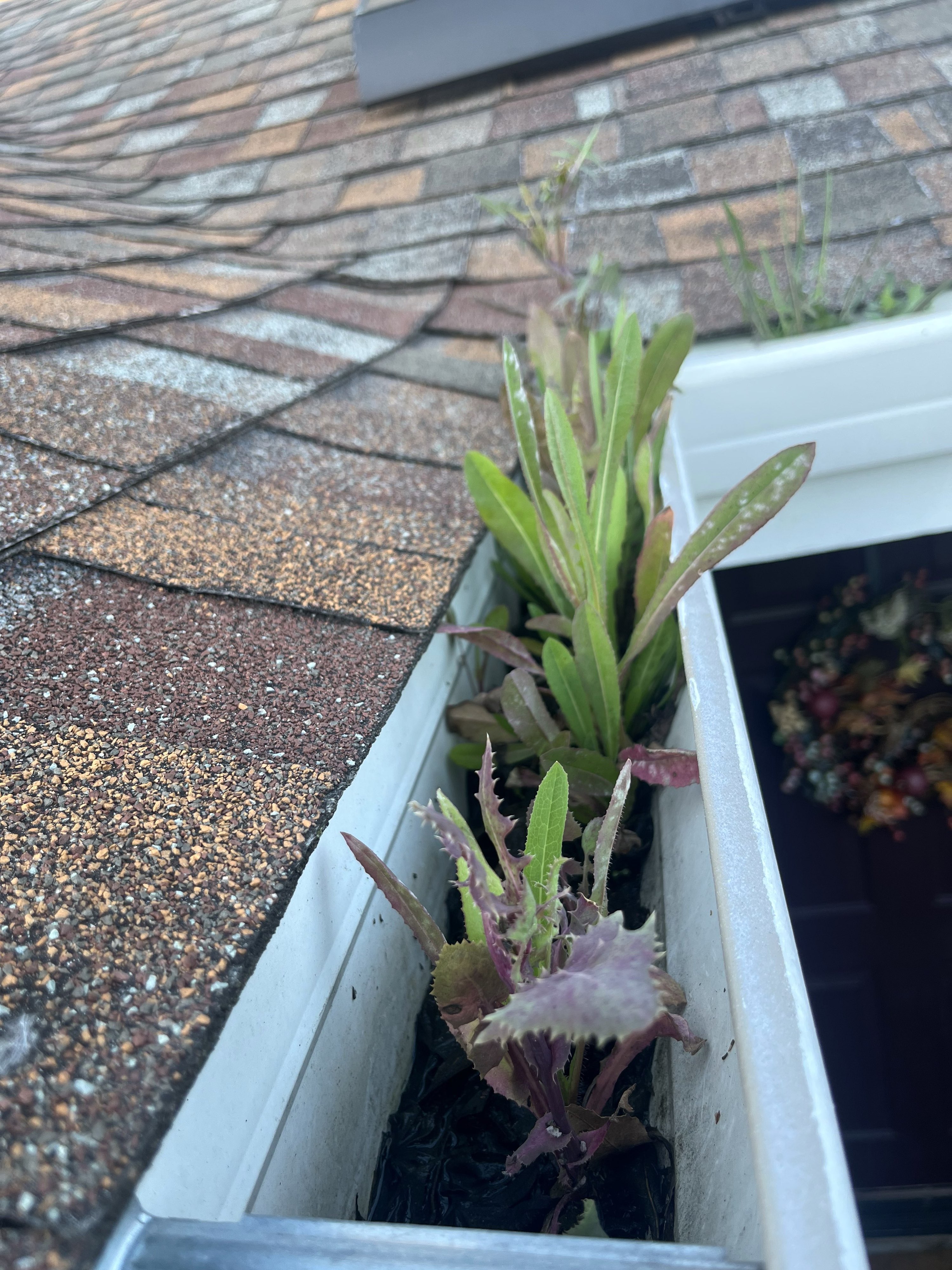
The foam inserts — the ones that fill the entire channel — are their own category. Moss and plant life love foam. They colonize it within a season. By year three, some of those inserts don't look like foam anymore. They look like a raised bed. The roots threading through them don't wash out.
Guards make inspection harder. You have to remove them to see what's underneath. Most homeowners never do. The problem runs longer before anyone finds it.
If you have guards on your gutters, the question isn't do I have guards? The question is: when did someone last pull them back and look underneath?
Sludge in the Dark
Not leaves. Not anymore.
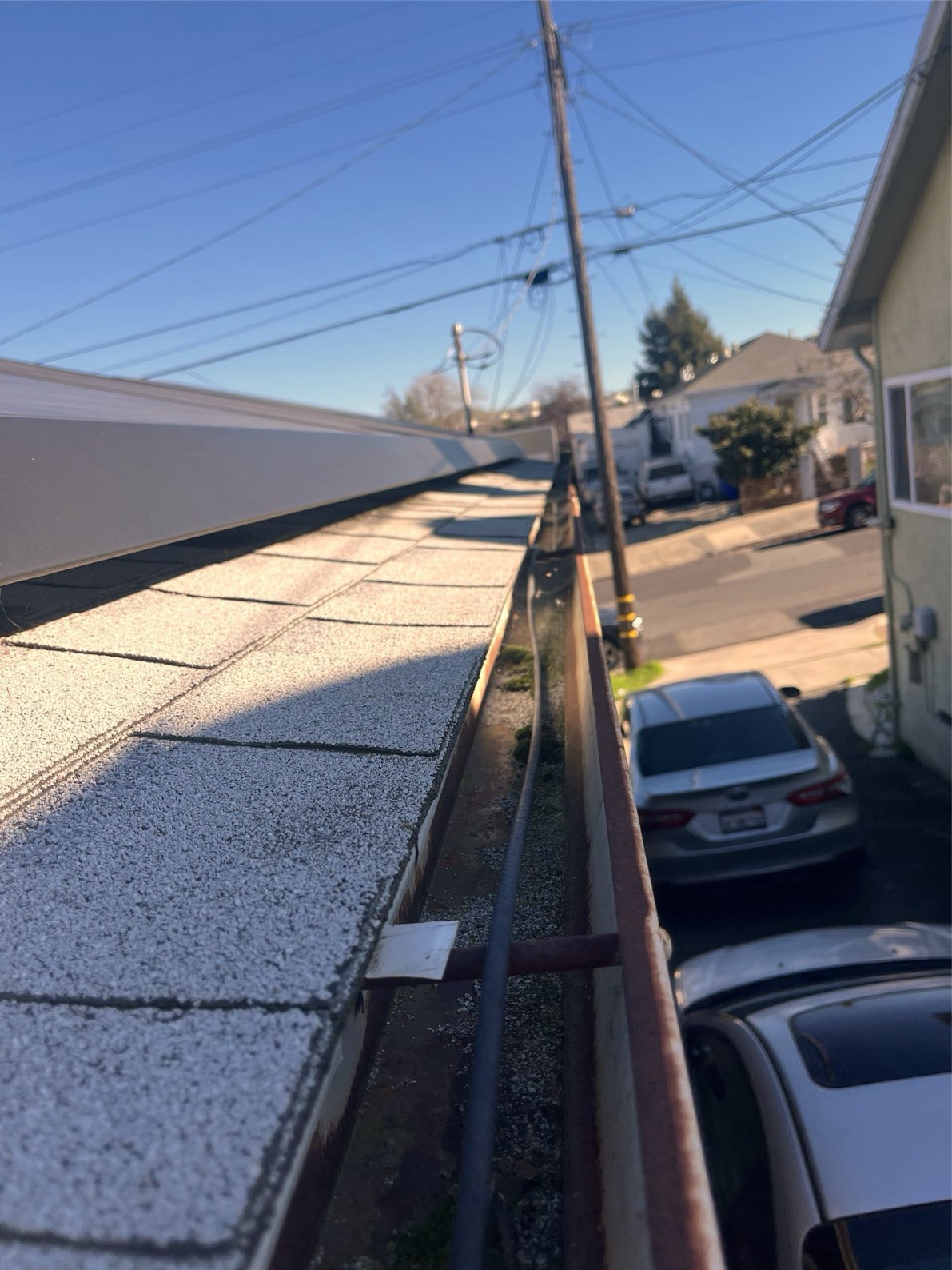
Bay laurel goes in and breaks down fast. Redwood needles take longer. Oak leaves are dense and waxy and slow, but they decompose too. What you're left with, layered against the gutter floor, looks almost exactly like potting soil — heavy, compacted, dark, moist enough in the middle to support root systems. Sometimes it does. Small plants thread through it. Moss colonizes the surface.
This material has weight. A ten-foot section of packed gutter sludge can run fifteen to twenty pounds. Your hangers weren't designed to carry that indefinitely. It pulls the gutter away from the fascia in small increments, season after season, until the pitch changes and water pools instead of flows — then works on the gutter floor until the floor gives.
Bay Laurel, Redwood,
and the Acids You Never Thought About
If you live in the coastal hills where the trees are old and the canopy is thick, this one is specifically for you.
Bay laurel leaves contain eucalyptol. Redwood needles are acidic. Tanoak leaves carry tannin content that makes your gutter's coating work harder than it was designed to. These aren't the same plants falling into gutters in other parts of the country. The organic chemistry of what your trees drop is more aggressive than what most gutter systems were built to handle over decades.
Add the way NorCal weather works: six to eight months of essentially no rain, followed by months of rain that arrives hard and sideways. Debris bakes on your roof all summer. Washes into your gutters in November. Sits there wet and acidic through March. Bakes again.
What those trees drop into your gutter isn't just debris — it's chemistry. Bay laurel, redwood, and eucalyptus all produce organic compounds that, as they decompose in standing water, turn that water acidic. Not dramatically. But enough, sustained through a wet season, to begin working on whatever the water is touching. The factory finish on your gutters. The zinc coating on the hardware. The painted aluminum interior. The process is slow. It doesn't announce itself. It just runs, wet season after wet season — and none of it shows from the driveway.
The Downspout That Goes Nowhere
Walk your property right now and find where your downspouts terminate.
Not the upper end — the lower end. Where does the water actually go when it exits the bottom of the downspout?
If your answer is "into the yard," follow up: how far from the foundation? A downspout with an elbow throwing water four feet from the house is doing its job. One that dumps straight down six inches from the wall is delivering your entire roof load to the same spot, storm after storm.
That six-inch dump site creates saturated soil close to the foundation. Soil that heaves in cold snaps. That pulls moisture toward porous concrete. That creates the conditions mold and mildew need on the interior of a crawl space.
Plenty of NorCal homes also have downspouts that were originally connected to underground drainage but aren't anymore. The plastic elbow got knocked loose. The underground pipe collapsed. The connection corroded. The downspout looks connected and isn't. Every storm, the full load goes straight down next to the wall. From the driveway, a disconnected downspout looks exactly like a working one.
The Sag You Haven't Measured
Your gutters are supposed to have pitch.
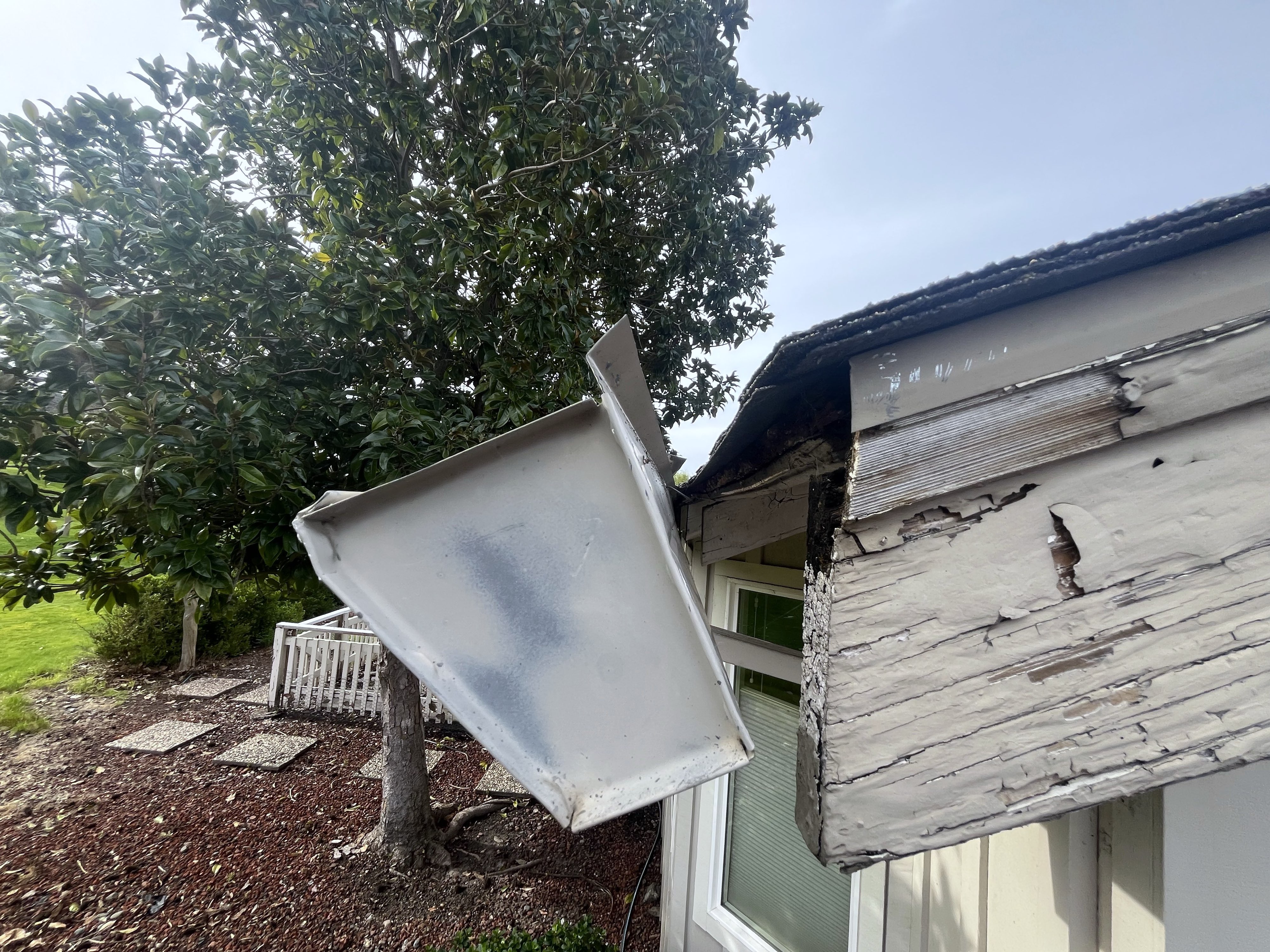
A slight decline — roughly a quarter inch for every ten feet of run — angling toward the downspout so water flows rather than pools. That pitch is set at installation. Over time, it changes.
Hangers loosen. Fascia wood swells and shrinks through wet seasons and dry ones. The weight of debris accumulation pulls the center of a long run down while the ends stay anchored. Any of these things — usually a combination — creates a low point in the middle where water gathers instead of flows.
A gutter that holds standing water between storms never fully dries. The organic material inside stays wet longer, decomposes faster, sits in acidic contact with the metal longer. Late summer it breeds mosquitoes. Every winter it carries more weight than the hangers were built for.
The sag is visible if you're at roofline height. From the ground, you're looking at the underside of the outer edge — which appears perfectly level even when the gutter floor is a shallow bowl.
The Seam That Let Go
Sectional gutters — the kind that come in ten-foot lengths joined with connectors and sealant — develop failures at the seams. Not a defect. Physics. The sealant has a lifespan, and NorCal's temperature range isn't gentle on it: forty-five degree winter nights, ninety-five degree August afternoons, repeat for twenty years.
When a seam fails, it starts small. A hairline gap. Water seeps through during heavy rain and runs down the back of the gutter — the side facing your fascia — where you will never see it from the ground. It wets the fascia board. Then the rafter tail behind it. If enough time passes, the ceiling of the eave.
By the time you notice a water stain on your siding below the gutter line, the seam has probably been leaking for more than one season. The evidence is on the wood behind it, which you'd have to be at ladder height to find. Sectional gutters over fifteen years old deserve a look at every joint. Not from the driveway. From the ladder.
The Fascia Behind the Curtain
Your fascia board is the horizontal wooden board your gutter mounts to. It runs the perimeter of your roofline and is almost entirely hidden behind the gutter — a few inches visible above the lip, nothing below.
Fascia wood rot is one of the most expensive and most predictable gutter-related repairs a homeowner faces. Predictable because the cause is always water: overflow that runs behind the gutter, a failed seam, a gutter that's pulled just far enough from the board to let moisture wick in.
The fascia doesn't rot fast. It rots over years. A little softness here, a little discoloration there, and then one day a hanger pulls out because the wood can no longer hold it. When a contractor pries the gutter away to replace the board, you see the full history — a stained, soft, sometimes black-centered board that was sending signals the whole time.
Replacing fascia boards means removing gutters, replacing the wood, priming, painting, and reinstalling. On a two-story home with full-perimeter fascia damage, you're well into five figures. The gutter hid all of it. That's what gutters do.
Debris That Isn't Leaves
Your roof shingles shed granules. Throughout their lifespan — especially in the first few years after installation and again as they age toward failure — asphalt shingles release mineral granules that wash into your gutters with every rain.
Check your downspout extension after a rain. If you see dark, gritty material that isn't soil, those are granules. Small amounts are normal. If you're scooping them out by the cupful, your roof is telling you something about its age and condition that has nothing to do with your gutters.
Granules don't decompose. They accumulate. They pack into the organic sludge layer and add weight and density. They settle into downspouts and create partial blockages you won't notice until a hard rain backs up behind the clog and overflows at exactly the wrong moment.
A gutter inspection tells you about your gutters. It also tells you something about your roof. The two are connected — the evidence of one shows up in the other.
The Cleaning You Moved to Fall
You know this pattern.
October arrives and the leaves are falling and you think: I'll clean them after they're done. So you wait. Then it's Thanksgiving and the weather turned. So you wait. Then December and the first storms hit and the north side is already overflowing, but the holidays are coming. So you wait.
Spring. Everything survived. You add gutters to the list. The list doesn't get shorter. Fall rolls around and here we are again.
The average homeowner cleaning cycle runs two to four storm seasons. The consequences of that timeline follow everything described in this piece: deeper sludge, more seam stress, more fascia moisture contact, more downspout blockage. At some point "maintenance" becomes "repair." The line between them isn't dramatic. It's just a matter of when the ladder went up last.
Tenants You Didn't Approve
Northern California has generous wildlife. The scrub jays, the acorn woodpeckers, the yellow jackets who build paper nests in every sheltered horizontal surface they can find — they are your neighbors, and they have strong opinions about your roofline.
Gutters are, from a bird's perspective, ideal nesting real estate. Protected from above, open from the front, pre-loaded with organic material. A pair of starlings can fill a six-foot section in under a week. The nest compacts against the downspout opening, creates a full blockage, and the gutter behaves as though it simply doesn't have a drain.
Yellow jackets and paper wasps favor the underside of gutter joints and the gap between the back of the gutter and the fascia board. You won't notice the nest until you're on the ladder, which is also exactly when the nest notices you.
Squirrels cache acorns in downspouts. This sounds like a joke. A packed downspout full of acorns and debris is a standard fall finding in Sonoma and Marin counties. It is not a joke. None of this is visible from the driveway.
The Staining You've Been Reading Wrong
Walk the exterior of your house and look at the siding below the gutter line.
If you see dark streaks running vertically down the siding — gray or brown stripes starting right where the gutter meets the fascia — that's a water story. The chapter it's telling is not about rain that fell correctly.
Two sources. The first is overflow: the gutter filled past capacity, water sheeted over the front edge, and ran down the siding repeatedly. The stain marks where overflow became routine. The second is a rear leak: water coming through a failed seam runs down the back of the gutter, wraps around the bottom edge, and appears on the siding as a stain that seems to come from nowhere.
Most homeowners look at those stains and think the gutters need cleaning — which may be true. But the stain is also logging seam condition, hanger placement, and overflow frequency. Cleaning alone won't fix any of that if the underlying geometry is wrong.
The stain is a record. It's been keeping notes on every storm since the last time someone fixed what was wrong. The length of the streak tells you roughly how long the record has been running.
The Overflow Training Your Soil
This is the quiet one. The one that's been working on your foundation while everything else had your attention.
Chronic gutter overflow — the kind that happens at the same location every moderate rain because the gutter is partially blocked or improperly pitched — deposits water at the base of your house in a consistent, predictable pattern. The soil there doesn't drain between storms. It stays saturated. It develops a depression as it compacts under repeated impact. That depression channels more water toward the foundation on the next storm.
The sequence from chronic overflow to foundation concern is not quick. It takes years. But the foundation doesn't announce the process while it's happening. What eventually shows up is efflorescence on a concrete wall — white mineral deposits left as water moves through porous concrete and evaporates on the other side — or moisture on the interior of a crawl space, or a door near a corner of the house that stopped closing the way it used to.
By the time any of that is visible, the gutter overflow that started it has been running for a long time. A clogged downspout and a compromised crawl space are not a close comparison in the repair column.
The Silence Itself
Every item in this piece has one thing in common.
None of them were loud.
The sludge accumulated quietly. The seam separated quietly. The fascia softened quietly. The downspout disconnected quietly. The sag developed over seasons with no drama, no announcement, no signal that the pitch was changing and water was starting to pool instead of flow.
Gutters are a slow-failure system. They don't break. They drift. They degrade in increments small enough that any single one doesn't justify a phone call or a morning on the ladder. The sludge is a little thicker this year than last, but it still drains mostly fine. The seam gap is a little wider, but it only leaks in the hard rains. The fascia has a soft spot, but the hanger is holding for now.
Each of those for nows accumulates the way the sludge does. And then one November, after the first real storm, you notice the water cascading over the front edge of the gutter on the north side, and the dark stain that appeared on the siding below it, and you think: I should have looked at this sooner.
Most of us should have. That's not a criticism. It's just what gutters do to the people who never had a reason to look closely — until they did.