The Question Nobody Asks Before Buying a Gutter Guard
Everyone asks what it looks like. What it costs. Whether it comes with a warranty. Nobody asks what metal it is — or what happens when unlike metals touch each other in standing water for twenty years.
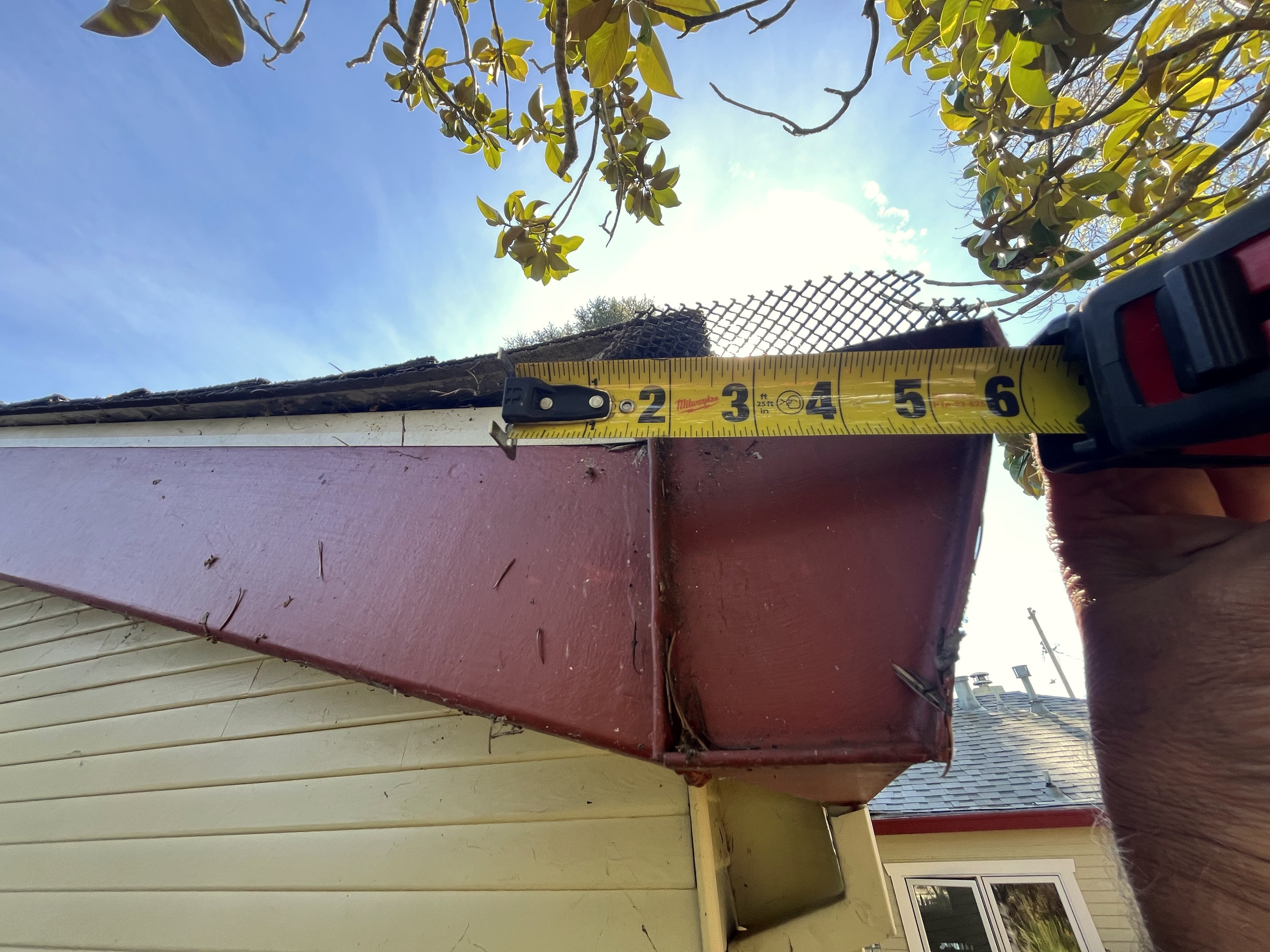
Your gutter guard was installed by a reputable company. It has a lifetime warranty. Nothing has clogged. From the driveway, everything looks exactly as it did the day the crew packed up and left.
What's been happening at the contact points between that guard and your gutter — year after year, wet season after wet season — is a different conversation. One that depends entirely on what metal your gutter is made of, and what metal the guard body is made of, and whether those two metals belong next to each other in standing water.
Across 1,500+ inspections in Marin, Sonoma, Napa, Lake, and Mendocino counties, the metal conversation is the one that never happened at the kitchen table. The guard is present. The warranty card is in a drawer. And on the ladder, the story the metal is telling at the attachment zones is not the one anyone described at the time of sale.
The question nobody asked at installation is the one that matters most now.
Two Profiles. Two Metals. One Question That's Different For Each.
Before the guard conversation makes sense, it matters what you're putting it on. Two distinct gutter profiles dominate the housing stock across Marin, Sonoma, Napa, Lake, and Mendocino counties — and they're made of different metals, with different behaviors when a guard is introduced.
Fascia-style gutters have a flat, wide face that mounts flush against the fascia board. Clean-lined, popular on homes built in roughly the last two decades, and increasingly the standard on new construction across the territory. The material is typically a steel alloy — coated with zinc galvanizing and a painted exterior finish. The flat front face is the visual giveaway from the ground. If your home was built after 2000 and has never had the gutters replaced, you likely have fascia-style.
OG or K-style gutters have a decorative S-curve profile on the front face — the ogee shape that's been on homes since the mid-20th century. These are aluminum. Formed seamless on-site from a coil of aluminum stock, painted, mounted to the fascia. Still the most common profile overall in the five-county territory, particularly on homes built before 2005. If your gutters have a curved, slightly ornate front rather than a flat face, this is what you have.
Flat front face, flush-mounted. Newer homes. Zinc-galvanized steel with exterior coating. The galvanic story here centers on coating degradation and rust progression from acid debris. The metal-to-metal galvanic mechanism is present but with a smaller potential gap than aluminum systems.
Decorative S-curve front profile. Older and mid-century homes. Aluminum alloy construction. The full galvanic dissolution mechanism described in this article applies here. The potential gap between aluminum and stainless steel is roughly 0.75–1.00 volts — the range where corrosion at contact points accelerates.
If you have fascia-style steel gutters: the acid debris chemistry your trees produce still attacks the zinc coating and the paint layer. Rust at hangers, seams, and screw points is the pattern to watch. The galvanic mechanism at the guard contact zone is a different, lower-magnitude concern — the potential gap between steel and stainless is smaller than the aluminum-to-stainless gap.
If you have OG aluminum gutters: the rest of this article is written directly for your situation. The potential gap, the NorCal electrolyte, the contact zone geometry — all of it applies.
Not sure which you have? Step back from your home and look at the front face of the gutter channel. Flat and wide with no decorative profile — fascia steel. Curved S-shape with a visible ogee contour — aluminum OG. That one observation routes everything that follows.
- Fascia steel: orange-brown rust streaks running vertically down the flat gutter face from hanger or screw points — zinc coating consumed at those locations
- OG aluminum: white or gray powder along the top edge or at clip points — oxidation where the coating has broken down
- Either type: paint bubbling or lifting on the gutter face near where the guard attaches — moisture working behind the finish
- Either type: the guard sitting slightly proud of the gutter edge at one or more points — something has shifted at the contact zone
A Battery You Did Not Know You Installed
A battery is two unlike metals in contact through a liquid. One metal corrodes. The other doesn't. The liquid is the circuit. Take away the liquid and the reaction slows. Keep it present — wet season after wet season — and the less noble metal slowly gives way.
Most gutter guard systems pair stainless steel mesh with a metal frame body. Most OG gutters are aluminum. Stainless steel and aluminum are unlike metals. The frame sits directly on the aluminum gutter wall at the attachment clips. The wet season fills that contact zone with liquid every year from October through April.
That's the battery. Already installed. Already running.
The reason this doesn't show up at installation — or at the five-year checkup — is that the process is slow. Not dramatic. No single wet season is the problem. It's the accumulation. Year seven through twelve is when the evidence starts appearing on the ladder. The guard looks identical from the driveway. What's changed is the aluminum at the contact points underneath it.
The homes I see most often with advanced corrosion at clip and attachment points are not the oldest homes. They're homes where a micro-mesh guard with a metal body was installed seven to twelve years ago. The metal looked fine from the driveway. From the ladder, the story at the contact points was different — pitting, white powder deposits, small gaps where the aluminum had receded from the attachment zone. The guard itself was intact. The metal underneath it wasn't.
Your Trees Are the Electrolyte
Coast redwood. California bay laurel. Eucalyptus. These are the canopy species that define the landscape across most of the five counties where I work. They're also the reason the galvanic risk in a Northern California gutter is not the same as the galvanic risk in a gutter in Phoenix or Chicago.
All three species produce organic debris — needles, fronds, leaves, bark — that, once it sits in standing water inside a gutter, turns the water acidic. Not battery-acid dramatic. But acidic enough, sustained through a wet season, to do real work on the surfaces it contacts. Researchers who study wood and metal corrosion have documented this chemistry specifically from NorCal canopy species. It's not a theory. It runs in your gutters from October through April.
Two things happen to your gutter under that sustained contact. First, the protective finish — the paint or coating on the aluminum interior — starts to break down. Not all at once. Progressively, season after season, until the bare aluminum underneath is exposed. Second, the zinc coating on steel hardware, hangers, and galvanized guard products begins to deplete. Zinc is the layer that slows rust. In most climates, it lasts decades. In an acidic environment like this one, it goes faster. When it's gone, the steel underneath is sitting directly in the liquid — unprotected, and in contact with the aluminum it was supposed to be shielding.
What makes this the electrolyte the galvanic reaction needs is that it conducts. Dissolved organic compounds carry charge. The liquid running through your gutter every wet season is corrosive enough to sustain an electrical current between dissimilar metals. Your trees have been supplying it every season since the day the gutters went up. It doesn't need your attention to keep working.
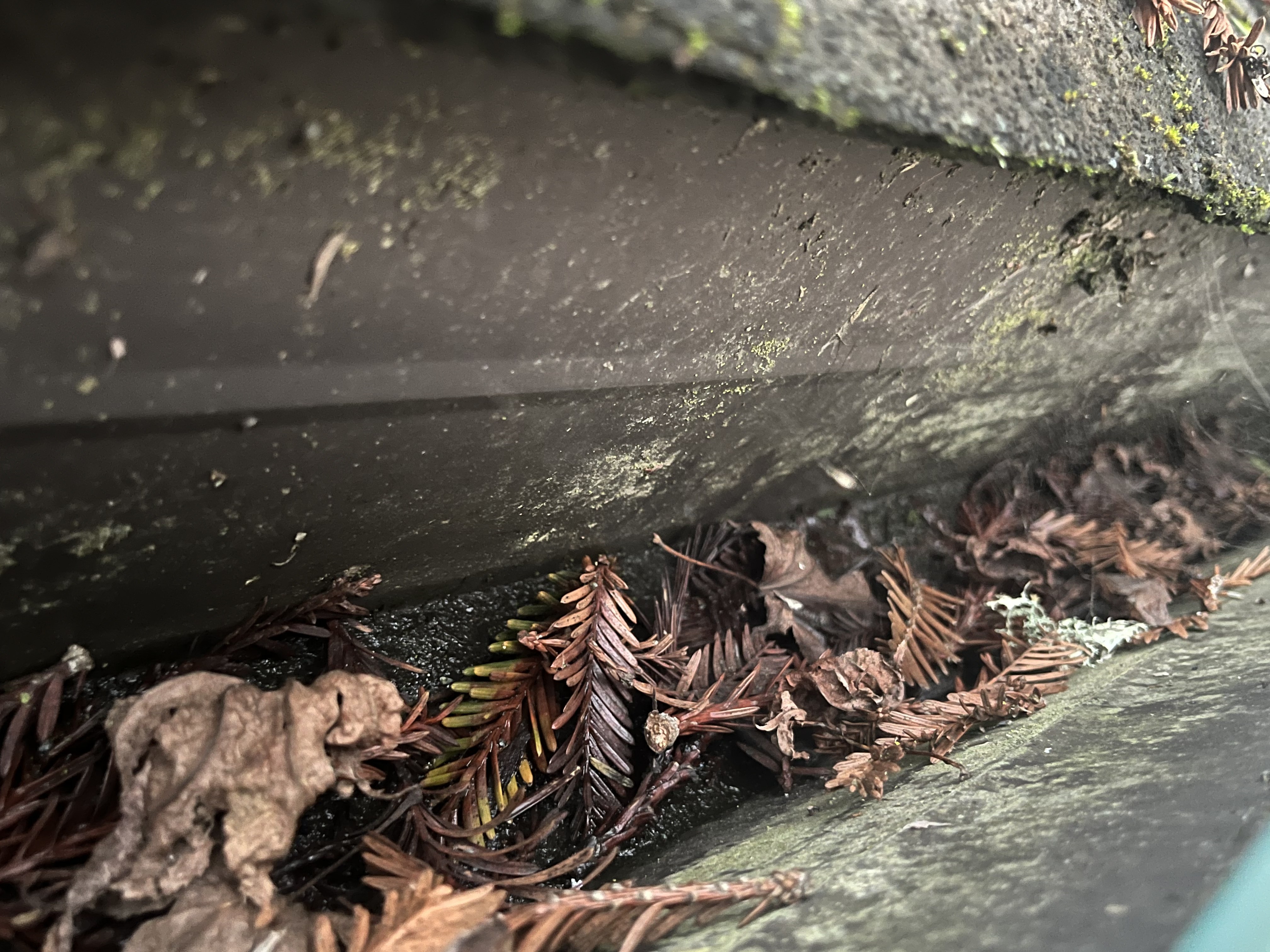
- A dark, tea-colored liquid draining from the downspout during rain — tannin runoff from decomposing debris
- Staining on concrete or pavers below the downspout outlet — persistent tannin deposits
- A faint vinegar-like or earthy smell when cleaning debris from the gutter — the decomposition is active
- Debris that has composted into soil rather than staying as recognizable leaves or needles — the process has been running for a long time
The Contact Point Is the Variable That Matters
The salesperson showed you the mesh. The installation crew pointed at the drainage angle. Nobody pointed at the contact zone — the place where the guard body physically rests on your aluminum gutter wall. That's the variable the conversation skipped.
A stainless steel micro-mesh gutter guard has two components: the mesh, which filters debris, and the body or frame, which sits on the gutter and holds the mesh in place. The mesh is almost always stainless steel. The body can be aluminum, stainless steel, or a non-conductive material like UPVC — a UV-stabilized form of PVC.
The galvanic risk does not live in the mesh. The mesh is up in the air. The galvanic risk lives at the contact point — the place where the guard body physically rests on the aluminum gutter wall. That contact point is where the electrical circuit either forms or doesn't.
If the body material at that contact point is metal — aluminum touching aluminum, no issue. Stainless steel touching aluminum — a galvanic couple with roughly 0.75 to 1.00 volts of potential. If the body material is non-conductive — UPVC, for example — no electrical circuit can form. UPVC is a dielectric material. It breaks the circuit between the stainless mesh above and the aluminum gutter below. The metals never touch. No circuit means no galvanic reaction, regardless of what the mesh is made of.
The same principle is used in structural steel connections where dissimilar metals must coexist — neoprene washers, rubber gaskets, dielectric fittings. The non-conductive material between them is the correct solution, used across engineering disciplines for exactly this reason.
Metal guard body in direct contact with aluminum gutter. Stainless-to-aluminum or steel-to-aluminum couple. Current flows in the presence of debris slurry. Aluminum corrodes at contact points over time.
Non-conductive body (UPVC) contacts the aluminum gutter. No electrical circuit can form between mesh and gutter regardless of mesh material. No galvanic reaction at contact zone.
The question is not which mesh is stronger. Stainless steel 316 is an excellent mesh material in almost every environment. The question is what's between the mesh and the gutter. That's the variable the warranty doesn't call out and the salesperson doesn't explain.
A Long Guard. A Few Small Spots. All the Damage in One Place.
Your gutter guard covers the entire roofline. Twenty, thirty, forty feet of stainless steel mesh running edge to edge. The contact points where it actually rests on the aluminum gutter are much smaller — clips, screws, attachment zones a few inches wide spaced every few feet.
Here's the problem with that proportion. When unlike metals are in contact and the galvanic reaction is running, the corrosion doesn't spread evenly across the whole surface. It concentrates. A large area of stainless steel in contact through a few small aluminum zones drives the reaction hard at those zones. Engineering standards that govern dissimilar metal connections in roofing and drainage systems specifically identify this pattern — large metal surface, small contact points — as the configuration where corrosion accelerates fastest.
What that means for your home: the rest of the gutter can look clean. The contact points don't. A ten-year-old guard installation can have a gutter that looks fine along ninety percent of its run and shows real damage at the handful of places where the guard clips sit. From the driveway, you're seeing the ninety percent.
I look at the contact points on every inspection where a metal-body guard is present. The condition of the gutter at those points — versus the condition of the gutter in between them — tells you whether the galvanic process has been active. On many homes it hasn't progressed far enough to be a near-term problem. On some it has. The homes where it's advanced are almost always the homes with the densest tree canopy — the highest organic debris load, the most active electrolyte season after season.
Zinc Protects You. Until It Runs Out.
Look at the rust streaks on a gutter face — the ones running down from a screw hole or a hanger point. That rust isn't coming from the aluminum. Aluminum oxidizes, but not that color, not that pattern. The rust is from the steel hardware beneath the zinc coating. The coating was supposed to protect it. At those spots, the coating is gone.
The complication is that zinc galvanizing is a finite coating, not a permanent property of the metal. Once the zinc layer is consumed, the underlying steel is exposed. And in a NorCal gutter with a pH 4.5 debris slurry running through it each wet season, that zinc coating depletes faster than it would in a dry or neutral environment. The American Galvanizers Association documents that zinc galvanizing loses protective performance below pH 5.5 — which is exactly the range the NorCal debris slurry occupies.
What starts as a protective zinc-on-aluminum pairing becomes, over time, a direct steel-on-aluminum couple as the zinc is consumed. The protection reverses. The corrosion dynamic shifts. The timeline depends on the coating thickness, the debris load, and how often the gutter is cleaned.
Field observation: rust staining on the exterior face of an aluminum gutter, particularly near hanger points and screws, is often the first visible sign that the zinc coating at those locations has been consumed. The rust isn't from the aluminum. It's from the steel underneath the galvanizing. By the time it's visible from the driveway, the zinc at those points is gone.
- Orange-brown rust streaks on the exterior gutter face running down from screw or hanger locations
- Small rust spots near the end caps or outlet connections where hardware is most concentrated
- A gutter section that appears to have shifted slightly — hanger corrosion can affect the hold
- Rust staining on the fascia board below a hanger point — the water running off the corroding metal is carrying iron oxide with it
What to Ask Before Anyone Gets on Your Roof
The conversation most homeowners have with a gutter guard installer covers mesh size, drainage rate, warranty length, and price. Those are all reasonable things to ask about. None of them address the material at the contact point.
One question does. Ask it before the contract is signed:
What material contacts the aluminum gutter — the guard body, the clips, the attachment hardware — and is any of it metal-to-metal with the gutter wall?
A knowledgeable installer answers without hesitation. They know what the frame body is made of. They know whether the clips make metal-to-metal contact with the gutter wall. They understand why you're asking.
If the answer redirects to mesh quality, warranty length, or price, the contact zone material hasn't entered the conversation. That's worth knowing before the contract is signed.
Your Gutters Have a Story. The Ground Doesn't Tell It.
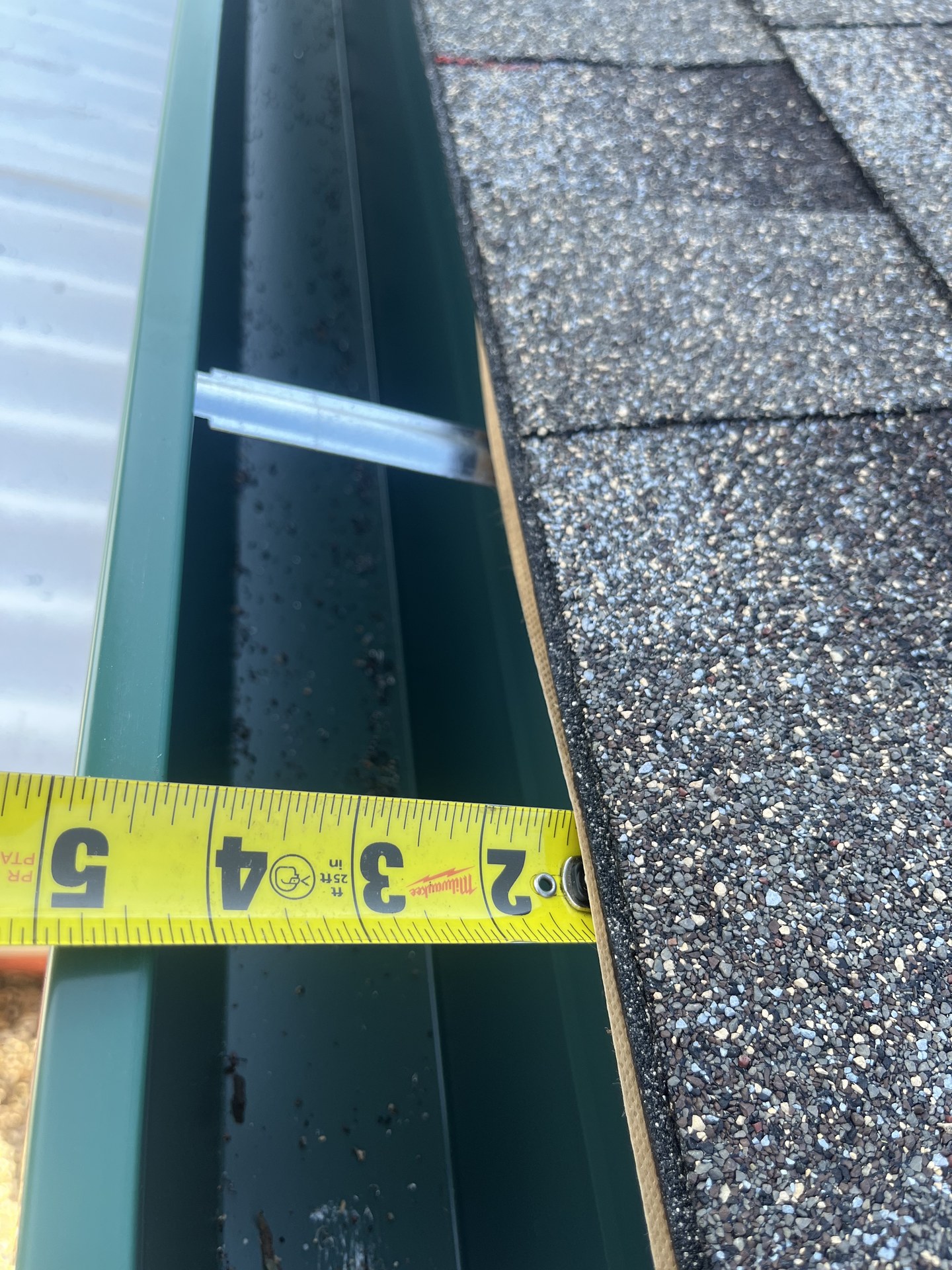
Your free inspection covers what's visible from the ladder — the contact points, the debris load, the condition of the metal at the places that matter. You get a written report the same day.
Schedule a Free InspectionCopper Flashing and the Chain Reaction Upstream
On older Marin and Sonoma County homes — particularly those built mid-century with chimney detail work around valleys and dormers — there is a second corrosion mechanism running upstream of the gutter. Copper flashing. When rain hits copper and runs into an aluminum gutter, it carries dissolved copper ions with it. Those ions deposit on the aluminum surface and create a localized galvanic cell — no second piece of copper needed. The aluminum beneath the deposit corrodes. This happens whether the gutter is covered or not.
When a micro-mesh guard with copper-infused stainless steel is also present on a home that has copper flashing upstream, the two mechanisms layer. The copper ion runoff from the flashing activates the aluminum surface. The guard's copper content adds a second source at the mesh level. In a NorCal acid debris environment, this is the highest-risk configuration in the gutter guard category. If your home was built before 1970 and has original chimney flashing, it's worth knowing which metal it is.
If your home has a chimney with metal flashing, look at the color of the flashing material. Gray-silver = steel or aluminum. Brown-green patina = copper. Copper flashing is common on homes built before 1970 and on high-end custom construction regardless of age. If you're uncertain, the roof inspection that precedes any gutter guard installation should include a note on flashing material.
The Guarantee and the Gap
Lifetime warranties are standard in the gutter guard industry. Most major brands offer them. Clog-free guarantees. Never-clog provisions with repair clauses. Transferable to new owners.
None explicitly warrant against galvanic corrosion of the aluminum gutter beneath the guard.
The warranty covers the guard — mesh, body, installation workmanship. The aluminum gutter is a separate component. If the contact zone has been corroding for a decade, the guard can be fully intact and fully covered while the gutter underneath needs replacement. Two different products. Two different invoices.
Replacing gutters on a two-story home with complex roofline geometry runs from roughly $3,000 to $8,000 depending on linear footage and access. That number doesn't appear anywhere in the original installation quote. That distinction rarely comes up until the gutter needs replacing. By then, the two invoices arrive at the same time.
What Only a Closer Look Can Tell You
From the driveway, a gutter with an active galvanic problem looks like any other gutter. The guard is present. The profile looks clean. The downspout is attached. Nothing is visibly overflowing or detached.
From the ladder, the contact points tell a different story. Oxidation builds first at the clip and screw locations — small, localized, easy to miss unless you're looking for it. Pitting follows at the aluminum wall where the guard body rests directly on the metal. In advanced cases, the gutter wall at those points has thinned. The guard is still mechanically attached. The metal holding it is not what it was.
A gutter inspection at ground level misses this entirely. A curbside assessment — even a thorough one — can document the guard type, the debris load, and the visible exterior condition. It can't document what's happening at the contact zone between the guard and the gutter. That requires being at eye level with the gutter, which means the ladder.
On homes where I find this pattern, the homeowner almost always says the same thing: the guard was installed by a reputable company, the warranty is lifetime, and nothing has ever clogged. All of that can be true. The corrosion at the contact points is a separate conversation — one that nobody had with them at the time of installation.
The debris keeps building. The wet season keeps running. The chemistry keeps working. Gutters are quiet that way.
- Any rust-colored staining on the gutter face — particularly near seams, screws, and hanger locations
- Paint lifting or bubbling on the gutter exterior near guard attachment points
- A visible gap between the guard edge and the gutter face at any point along the run
- Staining on the fascia board directly behind the gutter — water has been running behind the gutter face, not through it
- A section of gutter that appears to sag slightly more than adjacent sections — hanger integrity may be reduced
- Zelinka, S.L. & Stone, D.S. (2011). "The effect of tannins on the corrosion of steel fasteners embedded in wood." Materials and Corrosion, vol. 62, no. 8. Electrolyte behavior of tannin-rich organic decomposition in contact with metals.
- USDA Forest Products Laboratory. Research on corrosive properties of wood extractives — redwood, bay laurel, and eucalyptus tannin acid profiles and their interaction with metal fasteners.
- American Galvanizers Association. Galvanic series reference data; zinc galvanizing performance below pH 5.5 threshold; sacrificial zinc mechanism documentation.
- ASTM E3282. Standard Guide for Dissimilar Metal Corrosion — electrode potential reference values, cathode-to-anode area ratio effects, galvanic series for common construction metals.
- NRCA (National Roofing Contractors Association). Dissimilar metals guidance for roofing, drainage, and attachment system components.
The Ladder Is the Only Place This Gets Answered
What's happening at the contact points between your guard and your gutter isn't visible from the ground. A free inspection covers the full picture — materials, condition, debris load, and what the chemistry has been doing while no one was looking.
Schedule a Free Inspection