Forty Minutes on Your Property.
A vehicle pulls up. A ladder comes off the rack. A tape measure, a camera, a clipboard. That's the whole setup.
Forty minutes is the planning number. A one-story ranch on a flat lot wraps in thirty. A two-story hillside home with complex rooflines can run an hour. Your home lands somewhere in that window.
Book the inspection for a window when you'll be home. The ladder work is the first half. The second half is a fifteen-minute walk-through with you on the ground — the photographs reviewed on the tablet, the findings explained, your questions answered before the ladder packs up. Plan for about an hour of your time, start to finish.
The walk-through is where your gutter system turns into a conversation. You see the back wall of your own gutter. You watch the tape measurement play back. You ask what the rust line behind your downspout means for your fascia next winter. By the time the ladder goes back on the truck, you already know what your report is going to say.
When the ladder comes down, your roofline looks exactly as it did when the vehicle pulled in. The inspection adds a document to your records and leaves your system untouched.
The First Ten Minutes Are on Your Driveway.
Your fascia paint tells a story from the ground. Paint that has blistered, peeled, or darkened in vertical streaks is documenting water that has been running behind your gutter rather than through it. Every fascia run on your home gets photographed from the ground, on every side.
Your downspouts get documented next. Where does your water actually go when it leaves the downspout? Onto a splash block. Into a buried drain. Directly against your foundation. Into a planter bed. Each answer is a different conversation. Each gets photographed and noted.
Your siding below the gutter line tells you whether overflow has been happening for years. Staining on stucco, tannin runoff on painted wood, moss growing on shingle siding below a specific downspout — all of it is evidence of what's been happening above your eye line.
Your foundation and grading at the house wall close out the ground-level walk. Soil that has eroded away from your wall, a settled planter bed, concrete staining dark along one specific section — these are downstream symptoms of an upstream gutter problem. They matter for the conversation you'll have at the end.
Twenty to thirty photographs already exist on your report before the ladder ever goes up. All of them from the ground. All of them documenting what you could see for yourself if you knew where to look.
What Forty Feet of Reach Reveals.
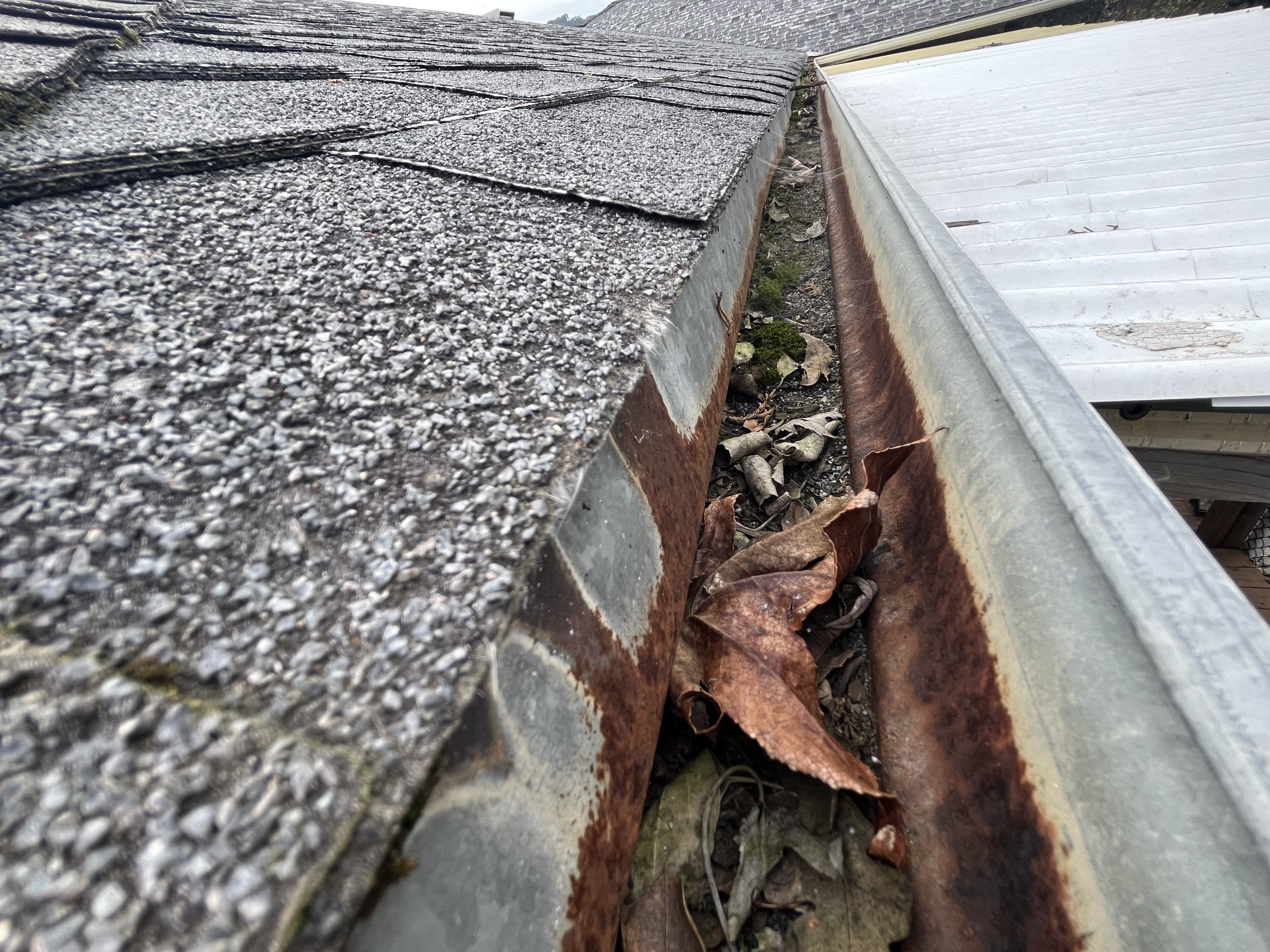
Ground evidence builds half your picture. The ladder builds the other half. Everything in the second half is information that lives above your eye line — the surfaces you'd only reach by climbing.
The back wall of your gutter is the first surface the ladder reveals. That wall contacts the fascia of your home. It's also the wall most prone to rust cascades, algae colonization, and tannin staining. From your driveway it's invisible. From the ladder it's the first thing looked at.
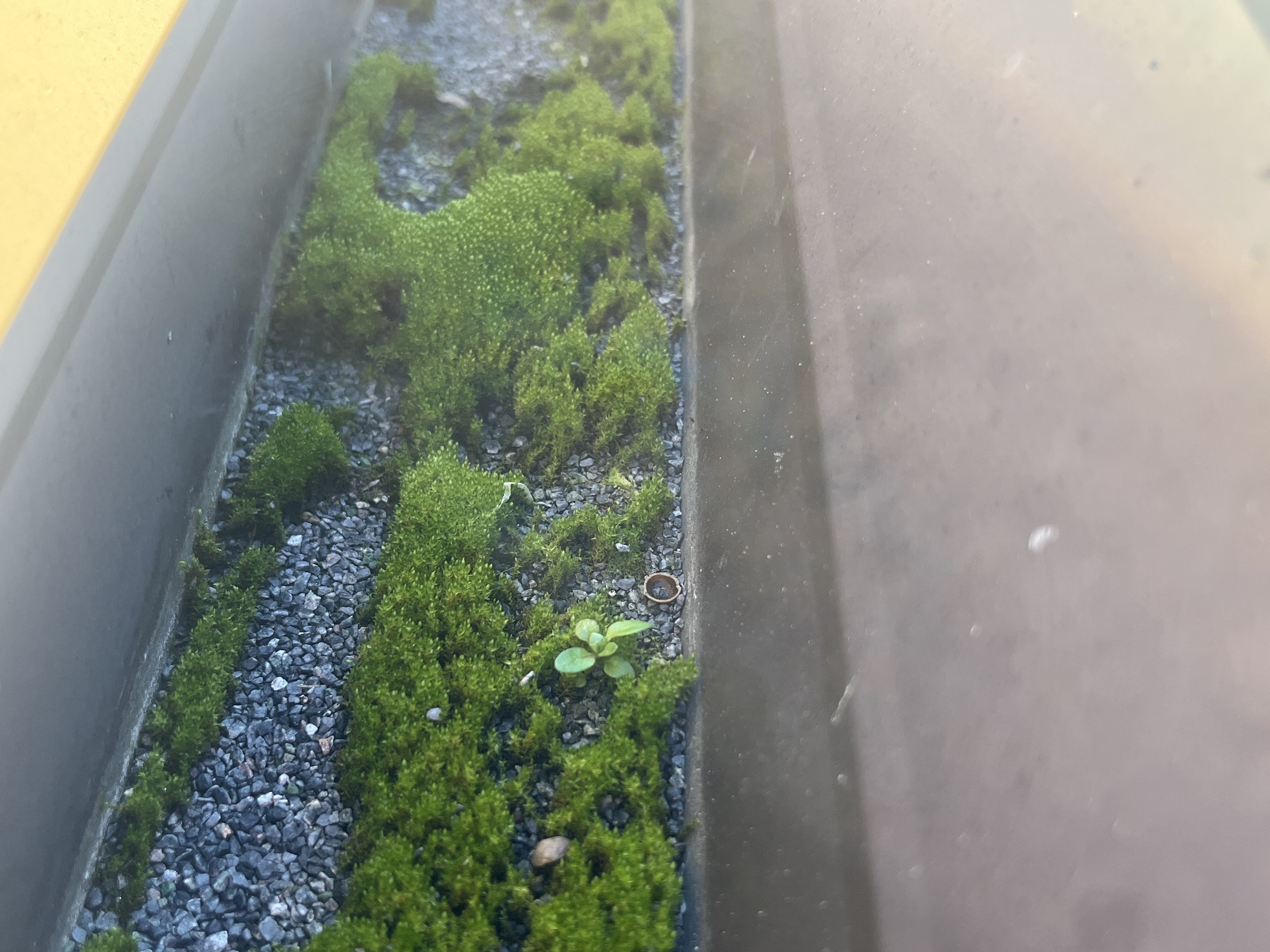
Your gutter interior comes next. Debris depth, debris composition — conifer needles, broadleaf, moss, catkins, sludge — standing water if present, seedlings and plant growth, fastener condition where your hangers penetrate, and any visible rust, pitting, or through-metal corrosion. Every finding gets a photograph with a reference object in frame when scale matters.
If you have guards, they get their own documentation track. The top surface of your guard. The perimeter seal where your guard meets the gutter lip. The interior beneath, lifted carefully if lifting is possible. Any shingle interference, flashing conflict, or debris accumulation on top of the guard itself.
Your shingle drip edge is the final ladder observation. Granule loss on your shingles is evidence of roof age and weathering. Granule sediment pooling in your gutter is evidence your roof is actively shedding material. Your drip edge flashing — present, absent, corroded, bent — gets documented on every run.
The ladder is slow work. Every run of your gutter gets its own set of photographs. A home with ten runs produces forty to sixty ladder-taken photographs on your inspection.
Every Finding, Measured.
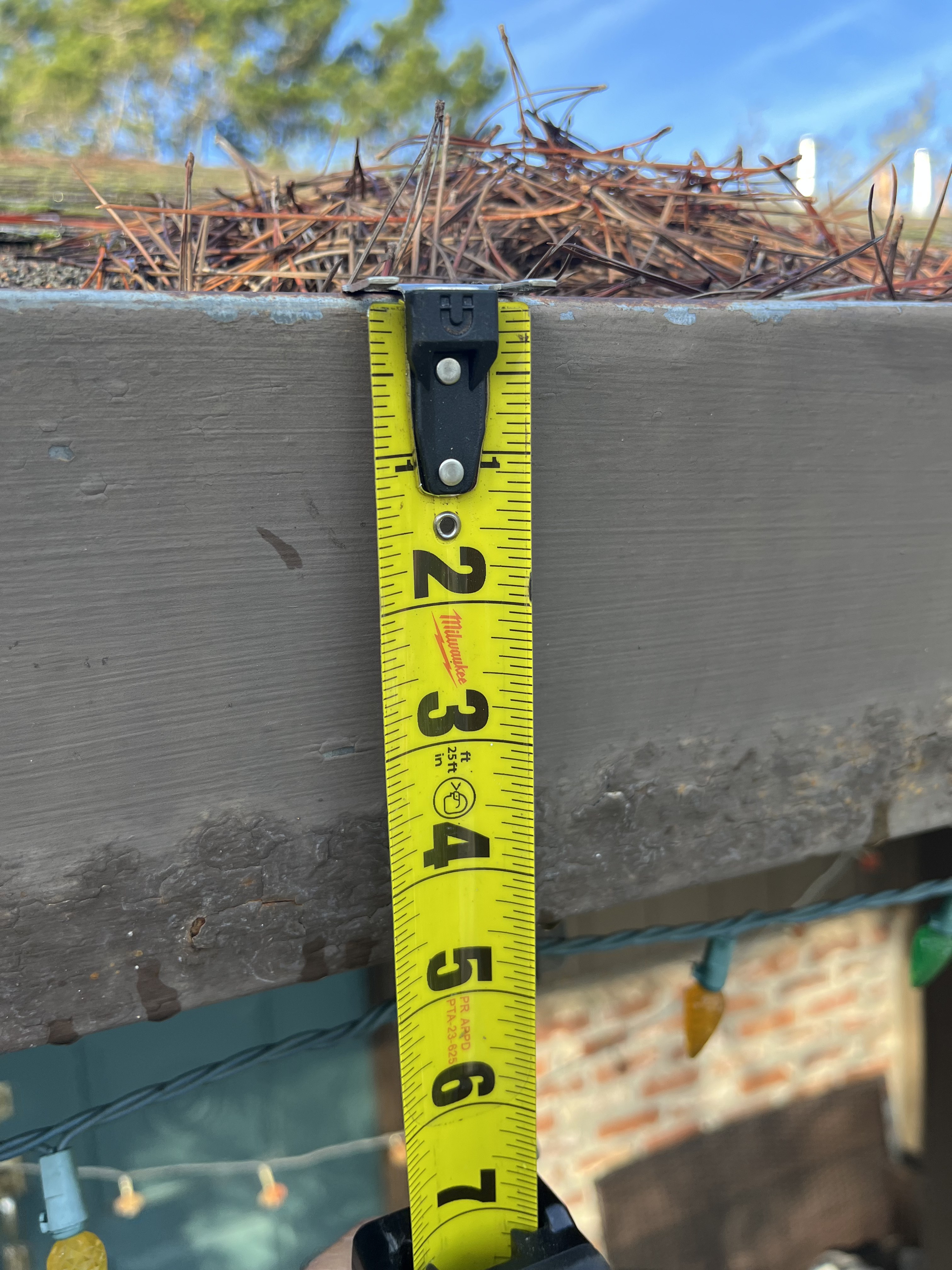
A description says "a lot of debris." A measurement says "six inches of debris packed into your five-inch gutter." The second version is what lands on your report, because it's what stands up to a contractor's quote, an insurance adjuster's claim file, or a buyer's specifics request during escrow.
The measurement tool is a Milwaukee tape — standard tradesman tool, rigid read, photographs clearly in any light. The tape shows in the frame every time a measurement happens, so you can verify the reading from the photograph itself.
Your inspection commonly measures gutter width at the opening, which distinguishes a standard five-inch K-style or fascia gutter from a narrower four-inch residential profile. Debris depth from the gutter floor upward, documenting exactly how much material has accumulated in yours. Standing water depth where it exists, separating a damp floor from a pooled section. Pitch deviation where visible sag has shifted your slope. Fascia soft spots probed with pressure where rot shows through the paint.
Numbers stand up. When your report says three inches of sludge with two inches of standing water on top, the photograph of the tape measure in frame is your citation. You can climb a ladder yourself and reproduce the reading from the same position.
This is the part of an inspection that separates a cursory look from a documentation event. A rough visual assessment is worth approximately what it costs. A measurement you can photograph, reproduce, and reference a year later is worth substantially more.
Every Finding, Photographed.
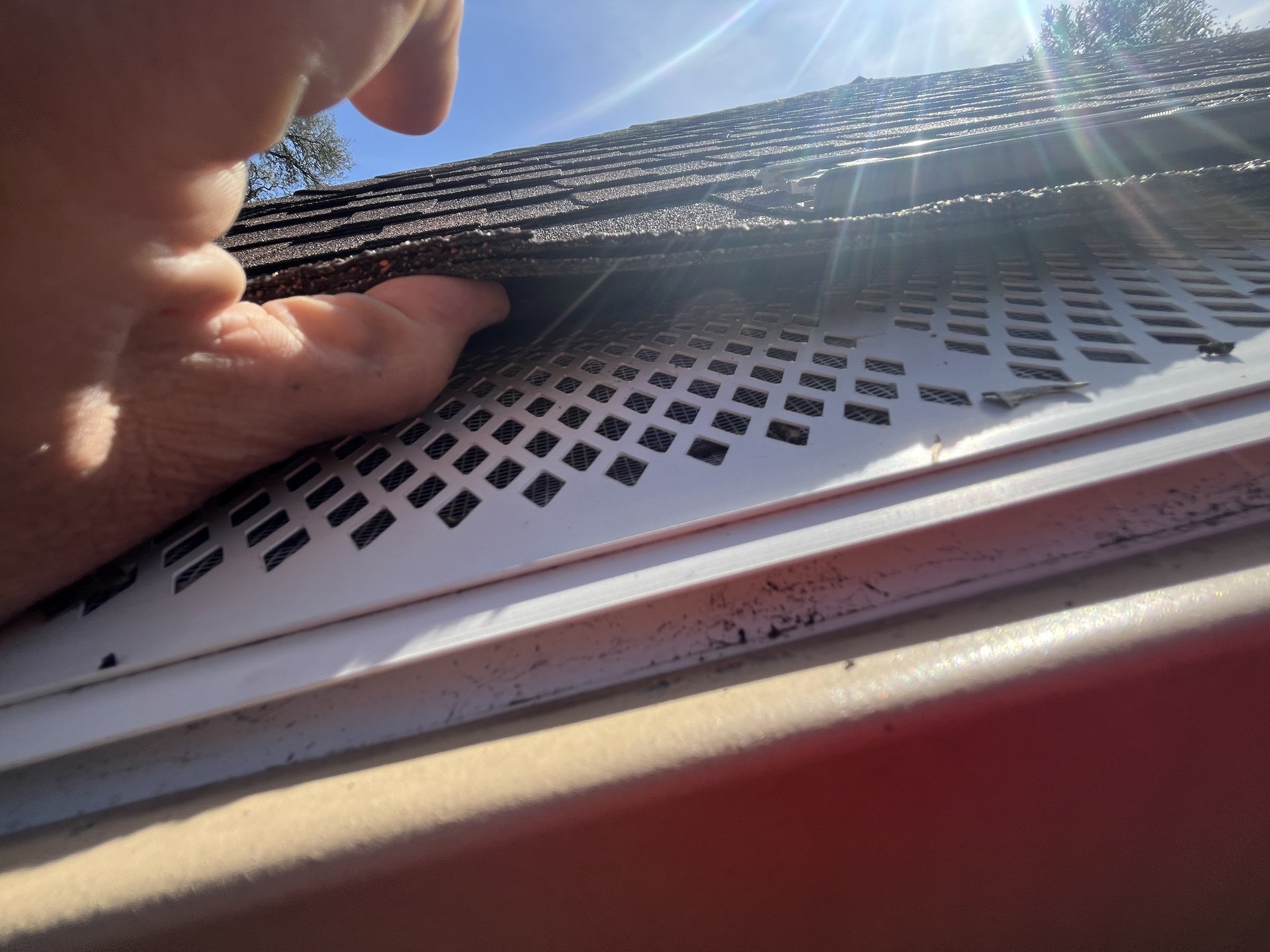
The photograph is your primary deliverable. Not the description. Not the measurement. Not the tier rating. The photograph. Everything else is annotation on your photograph.
Sixty to one hundred photographs land on your report on a typical inspection. Wide shots that establish orientation — which side of your home, which gutter run, which downspout. Mid-range shots that capture an entire finding in context. Close-up shots that document a specific condition at detail resolution. Reference shots with tape measure or hand for scale. Hand-lifted reveal shots where your guard is lifted carefully to show what's underneath, with the installation left intact.
Every photograph on your report carries a caption describing what's in the frame, why it matters, and how it connects to your overall tier rating. Photographs without captions are decoration. Your report runs on captions.
Your photographs live on your document in the form delivered to your email. You forward them to a contractor requesting a quote. You forward them to a buyer reviewing your home during escrow. You forward them to an insurance adjuster processing a claim. You forward them to a spouse asking what the ladder actually revealed.
Your privacy stays with you. Every photograph focuses on your gutter system — the back wall, the interior, the fascia line, the drip edge, the downspout. Your home number, your license plate, and your front door stay out of every frame by design. The document is evidence about your gutters, not about your address.
Five Ratings. One Document.
Every inspection produces one overall severity rating on a five-tier scale. Your tier is the executive summary — the headline you can read in thirty seconds and understand, backed by the photographs underneath.
Tier 1 — Clear. Your gutter system is doing the job it was installed to do. Debris minimal or absent. No standing water in your channels. Hangers holding your pitch. Fascia intact behind every run. Paint stable. Seasonal cleaning is your only action item. Rare across the inspection archive — fewer than one in five homes lands at Tier 1 on first inspection.
Tier 2 — Maintenance Stage. Findings exist on your home but none need immediate attention. Debris has begun accumulating. Minor paint wear shows in localized sections. Fastener corrosion is present but not structurally compromised. A cleaning and touch-up this season handles everything on your report. The most common outcome on homes inspected within three years of installation or most recent cleaning.
Tier 3 — Active Issues. Sludge inside your channel. Moss colonization established. Seedlings germinating on your gutter floor. Standing water documented. Early interior rust visible on your back wall. Your findings describe sustained moisture conditions that have been running long enough for biology to move in. Attention this season prevents progression to Tier 4. The single most common tier across the five-county inspection archive.
Tier 4 — Damage in Progress. Interior rust cascades on your back wall. Fascia staining visible behind your gutter line. Pitch loss measurable. Guard failures if you have guards installed. Through-metal corrosion beginning. Your gutter system is still functioning, but your damage clock is running. Your home is in this tier if your gutters have gone five to ten years without intervening maintenance.
Tier 5 — Structural Emergency. Your gutters have detached. Through-metal failure. Fascia rot has reached your structural wood. Active water damage behind your gutter line or into your soffit. Tier 5 is the rating where the question stops being "is it failing" and becomes "how much of your surrounding structure is already compromised." Every Tier 5 in the archive came with photographs showing water had been working behind the gutter line for years before anyone put a ladder up.
Your tier is evidence-based. Photographs back every assignment. You see exactly which findings drove your rating.
Same Day. Written. Yours to Keep.
Your ground-level walk-through is your first look at the findings. Photographs on the tablet, key measurements explained, questions answered while everything is fresh. The written report is the complete version of what you just saw, delivered to your inbox the same day.
Most written reports land within two to four hours of the ladder coming down. The format is a PDF — fifteen to thirty pages depending on your home size and finding density — built to the same structure on every home, so if your neighbor also booked, your two reports read the same way.
Page one carries your tier rating, your property address, your inspection date, and a two-paragraph summary of your findings. Page two breaks down findings by section. The remainder of your document carries the photographs with captions, grouped by gutter run.
Your report reads linearly. First page to last page tells the story of your inspection in the order the ladder walked it. Read only page one, and you have the headline. Read to page five, and you have the specifics. Read the full document, and you have the same granular picture the ladder had on your roofline this morning.
Your document carries no license restriction. Forward it. Print it. Upload it to your cloud. Reference it three years from now. Sell your home next spring and hand it to the buyer as documented condition evidence. File an insurance claim after a storm and use your report as baseline documentation from before the storm. Request a cleaning quote and let your contractor quote from specifics instead of a drive-by.
117 Data Points. Grouped by Section.
Your 117 data points are the granular detail layer beneath your tier rating. Every homeowner gets the same checklist walked on the same structure. Your findings are your own; the discipline is consistent.
The data points group into eight sections. Structural covers your gutter attachment, your hanger condition, your pitch, your sag, your seam integrity, your corner miter condition, and your detachment risk. Debris covers composition, depth, distribution, compaction, and biological colonization inside your channel. Chemistry covers your back wall condition, interior rust, tannin staining, algae presence, and moss establishment. Hardware covers your hangers, clips, brackets, fastener rust, downspout strap integrity, and any installed guards or protection devices.
Water flow covers standing water, pitch correction points, overflow evidence, splashback staining, and diversion patterns on your home. Fascia covers your paint condition, wood integrity, rot probing results, and moisture staining behind your gutter line. Roof edge covers shingle drip edge condition, granule loss, drip edge flashing, and any interface issues between your roof and your gutter. Drainage covers your downspout termination, splash block condition, grading at the house line, and where your water actually goes after it leaves the system.
Every point gets a value — present, absent, documented, flagged. Your high-consequence flags appear on page one of your report as the top-level findings. Read only page one and you have the ten or fifteen items that drove your tier rating. Read the full document and you have the rest.
Your Document Has More Uses Than You Think.
You live in your home and want to know what's happening on your roofline. That's the most common reason to book. Several other reasons show up across the inspection archive.
You're buying a home and you're in escrow. Your standard home inspection covers gutters at a surface level. A dedicated gutter inspection gives you granular condition evidence you can use in negotiation, repair requests, or your closing decision — while the due diligence window is still open.
You're selling and preparing for market. A Tier 1 or Tier 2 report becomes a disclosure asset — documented evidence your gutter system is sound, shared with buyer representatives at showings. A Tier 4 or Tier 5 report becomes a pricing conversation — your condition gets priced into your listing instead of discovered during escrow and renegotiated.
You're a landlord with multiple properties. Quarterly or annual inspections across your portfolio keep condition records on every property, including the ones you don't drive past regularly. Your maintenance budget aligns with documented findings instead of complaint calls from tenants.
You're filing an insurance claim after a storm. Your pre-storm report is your baseline. A report from before the wind event plus documentation from after produces a claim file that processes faster and with fewer disputes than a claim built on memory.
You're the spouse who wants the written record. Your partner came home with a story about the gutters. You want the evidence, photographed, before you agree to anything. Your report settles the conversation with images rather than opinions.
The Ladder Is the Only Place This Gets Answered.
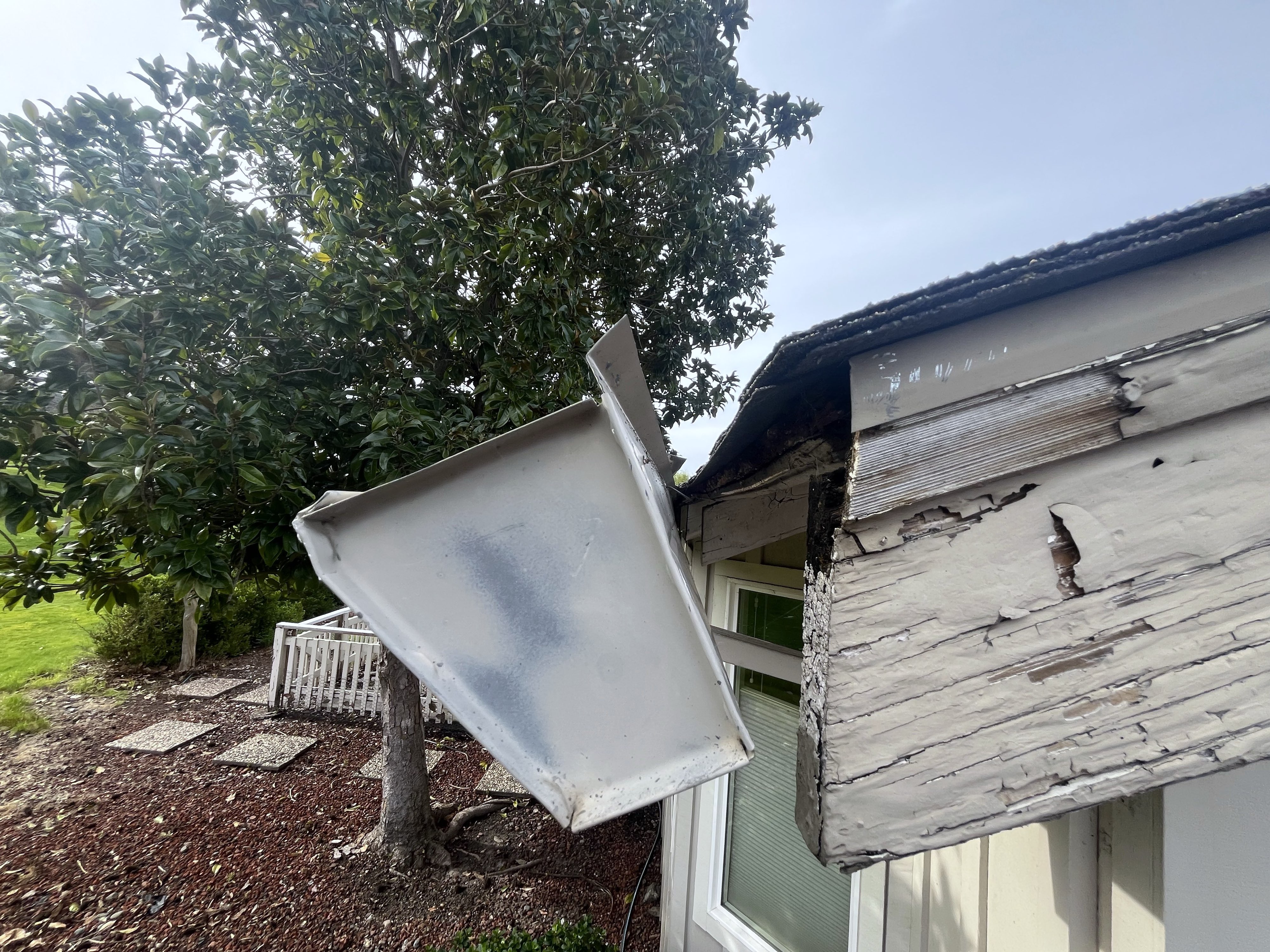
Software skips your back wall. A drone never touches your fascia board. A visual walk-by from the sidewalk misses the entire ladder half of your story by physics alone.
The ladder is the tool. The tape measure is the instrument. The camera is the record. The report is the output. Forty minutes on your property produces a document that outlasts every memory of the conversation. Yours to keep, yours to share, yours to reference ten years from now.
What you just read is a description of a methodology — the same methodology your inspection will walk when the vehicle pulls into your driveway in Marin, Sonoma, Napa, Lake, or Mendocino.