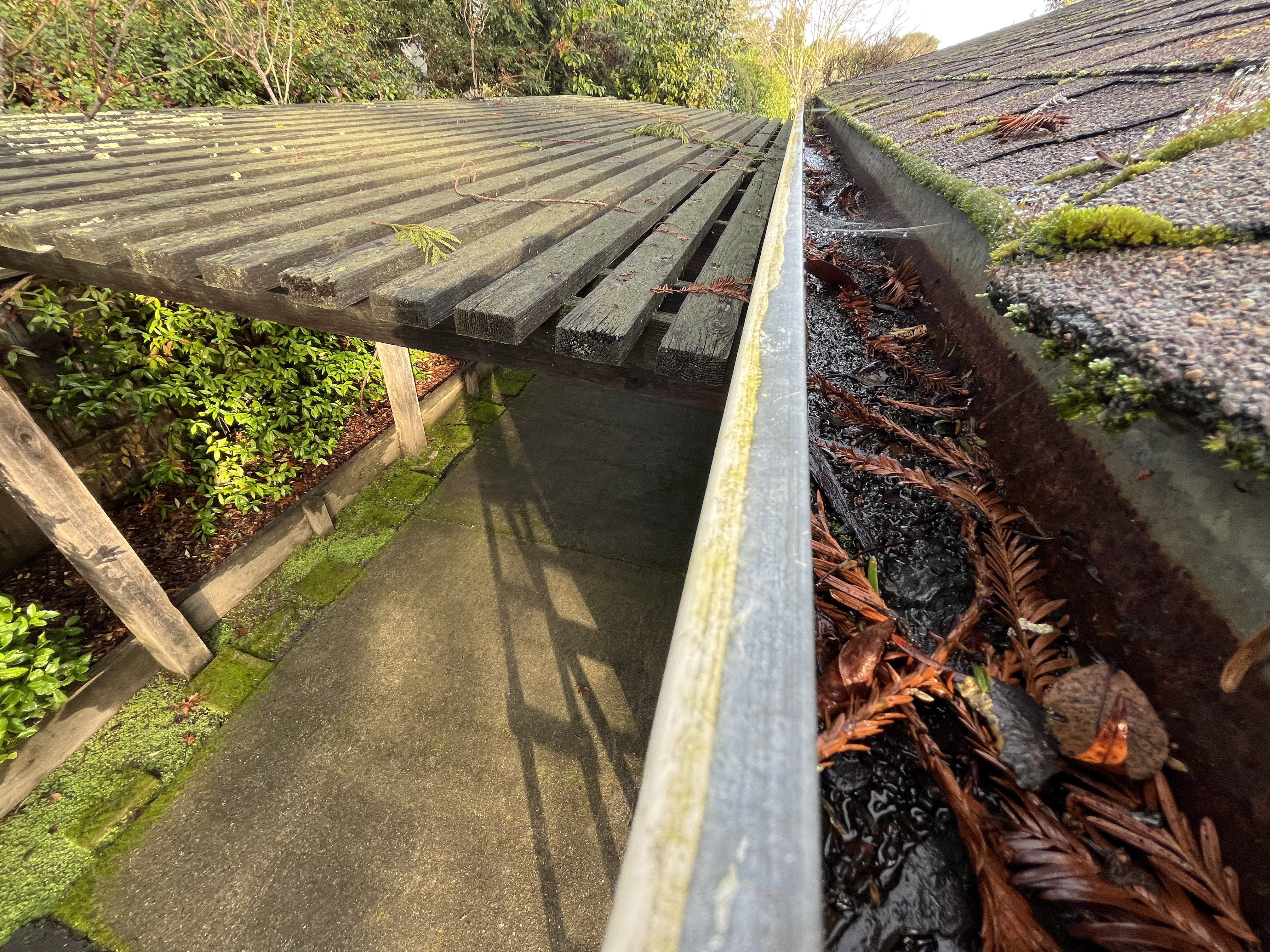
The Downspout That Stops Draining
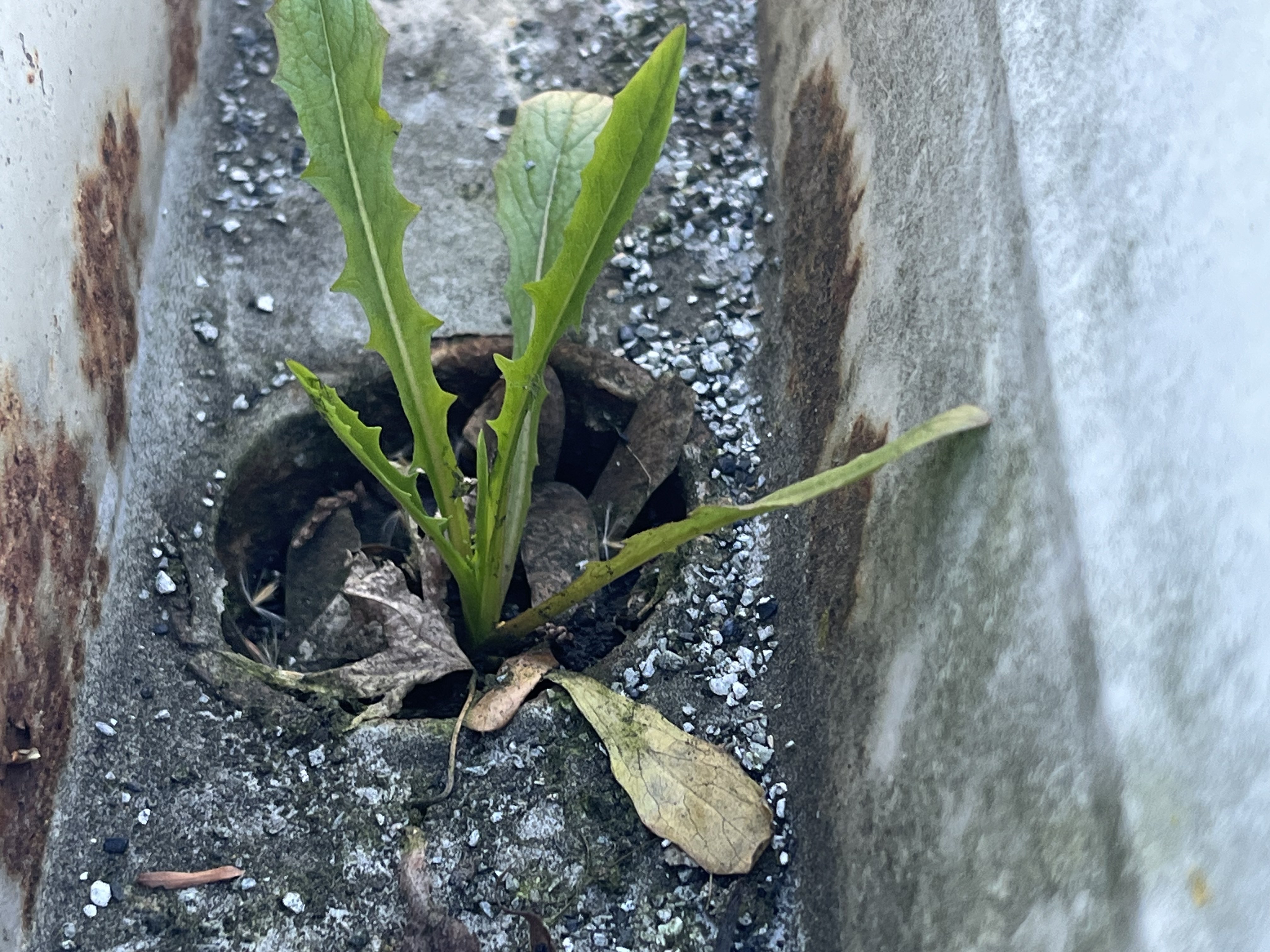
The chain begins at one downspout — usually at one corner of your house, almost always on the side that faces your most active tree. Debris packs the outlet. Water that should leave the gutter through the drain finds the path of least resistance instead, which is over the front lip. Your downspout is no longer a downspout. It is a wall.
If you check this stage one weekend in September with a garden hose and a pair of gloves, the fix takes five minutes. The cost is whatever your gloves cost. The chain ends here, before stage two has a chance to begin.
The Same Spot Overflows in Every Storm
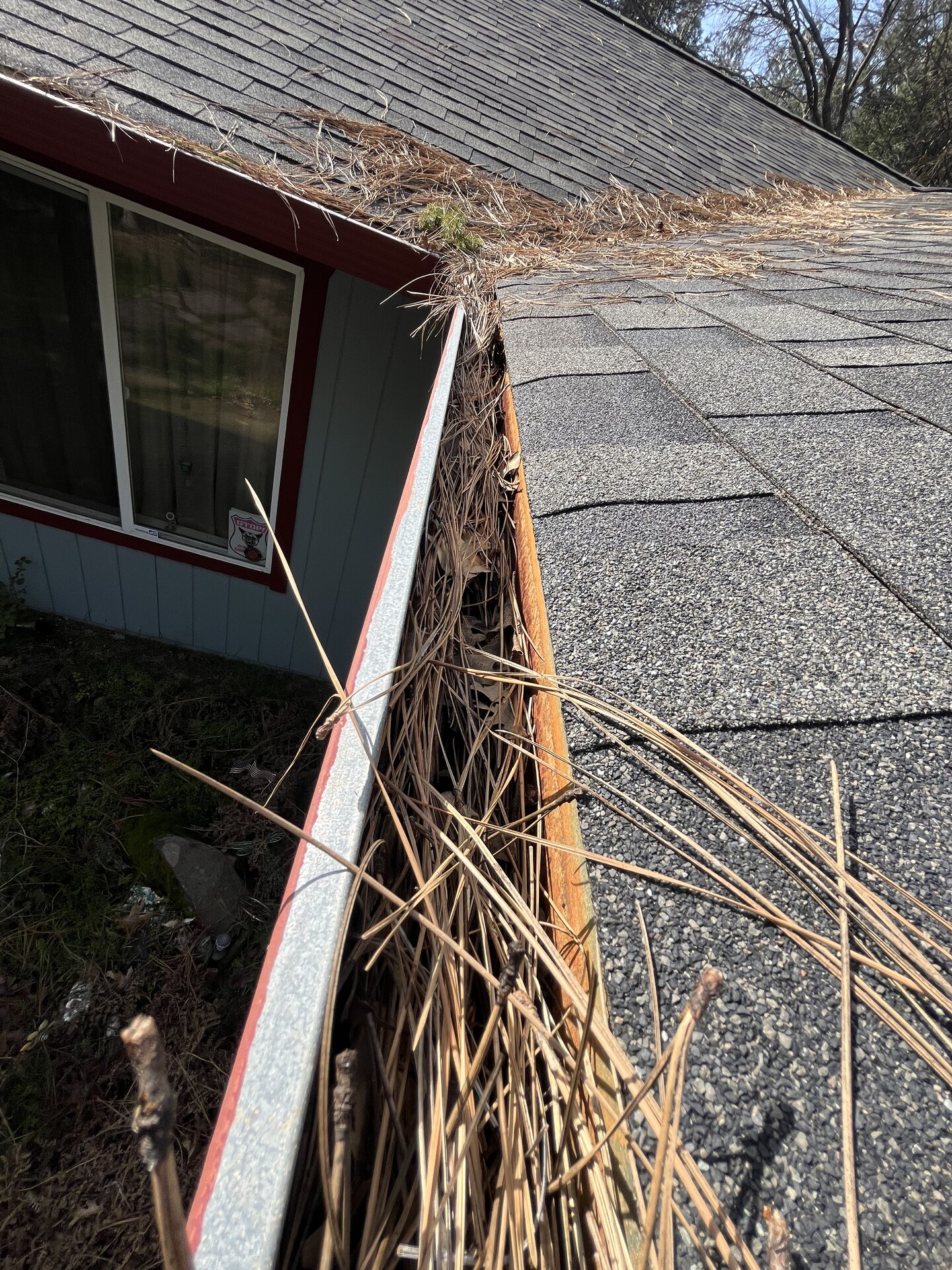
With the downspout sealed off, the gutter overflows in the same spot every time it rains. The first storm is a curiosity — water cascading over a corner. By the third storm, the location is predictable. By the wet season's end, the streak on the siding below the overflow point is permanent.
This is the stage where most homeowners notice something is wrong. The visible signal is the streak on the siding directly below the overflow point — the kind of vertical staining covered in another piece in this series. The fix at stage two is gutter cleaning plus downspout clearing — typically a few hundred dollars. The chain still ends here, but it will not end on its own. Cleaning is required.
The Same Soil Stays Wet
Year after year of storm water dumping in the same spot trains the soil. The ground at that corner of your house no longer drains the way the rest of your yard does. Wet patches stay wet for days after a storm. Mulch washes away. A small ring of moss-loving plants takes hold near the base of the wall. If you have a downspout extension, the deposit point is the spot where everything always stays soaked.
The repair scope at this stage adds drainage work to the gutter cleaning — a downspout extension, a splash block, sometimes regrading the soil away from the foundation. The fix is still measured in hundreds of dollars, but you are no longer just fixing the gutter. You are also undoing what the gutter wrote into the ground.
The Patio Shows Its Notes
By stage four, the surface around the overflow point has been keeping a record long enough that the record is visible from your driveway. Concrete patios near the deposit point develop a green moss carpet — exactly the kind of thing in the photo that opens this piece. Stone or paver surfaces bloom efflorescence at the base of any wall the water reaches. Cracks in concrete grow seasonally, opening half a millimeter wider each wet season.
The repairs at this stage start to cross between drainage work and surface remediation. You are now removing moss from concrete, sealing cracks, sometimes pressure-washing efflorescence off block walls. The gutter is still part of the conversation, but the conversation has expanded.
The Soffit Starts Staining
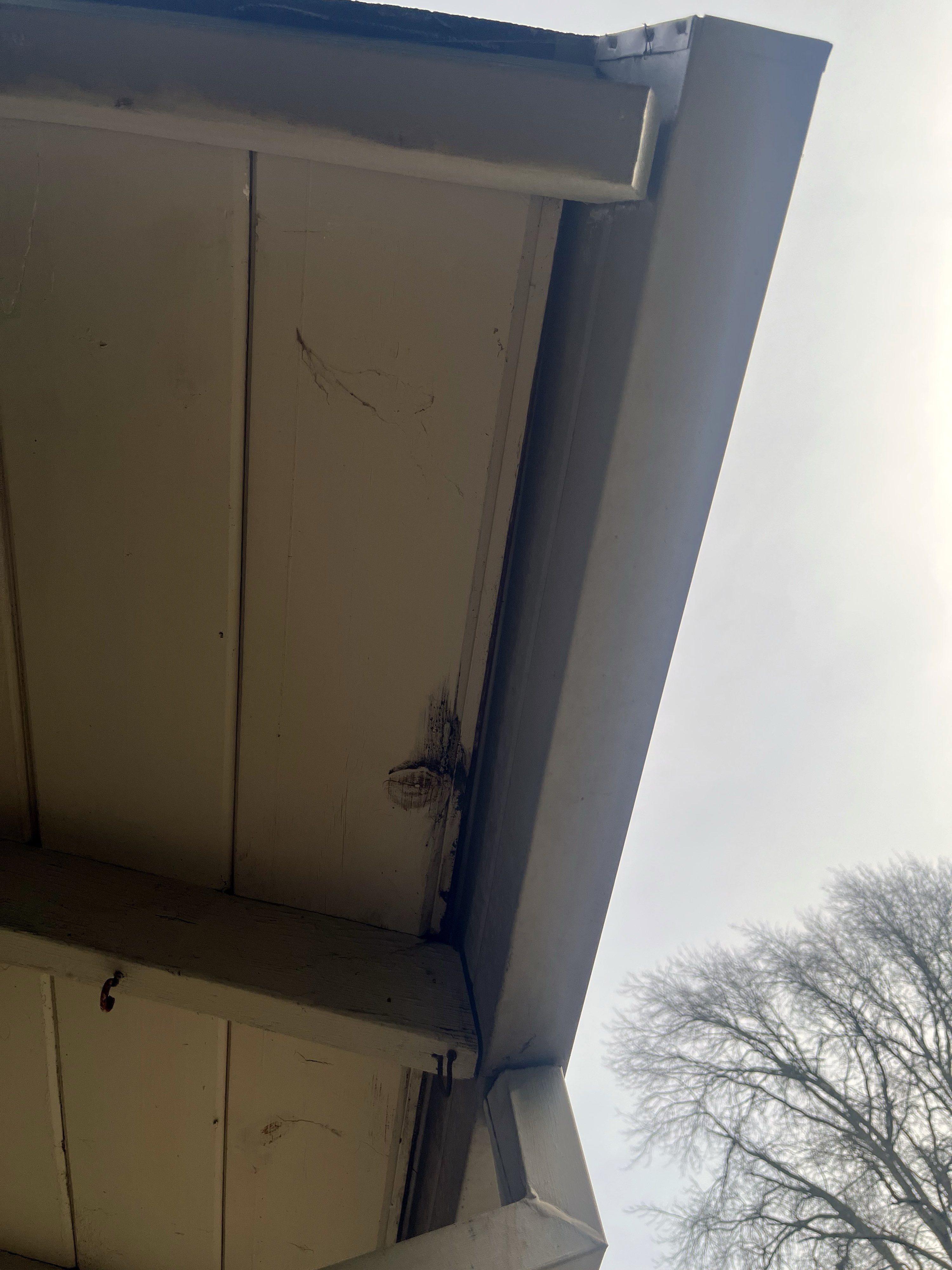
Stage five is when the overflow stops being a drainage problem and becomes a building envelope problem. Sustained water exposure where the gutter meets the fascia lets moisture wick into the soffit — the underside of your eave. A brown stain appears where the soffit meets the wall. Paint on that stretch of wall begins blistering. The corner of your house starts looking different than the rest from the street.
The repair scope at this stage adds carpentry to drainage. Soffit material may need replacement. Fascia behind the gutter may have rot — a different chapter of the same story, covered in another piece in this series. You are now into multiple trades and multiple thousands of dollars.
The Crawl Space Notices
By stage six, water has been arriving at the foundation perimeter for long enough that some of it has found a way underneath. Crawl space humidity rises. The smell changes. If you have a sump pump, it runs more than it used to. If you do not have one, you may need to.
The repair scope at this stage adds foundation work to envelope work to drainage work. French drains, exterior waterproofing, sometimes pier work depending on how the soil has shifted. The original five-minute downspout fix has now grown into a project that involves three or four trades and tens of thousands of dollars.
The Door Stops Closing
Stage seven is the moment most homeowners finally recognize something is wrong with their house. A door near a corner of the building no longer closes the way it used to. A crack appears in drywall above a window on the same side. The floor near that corner feels slightly different. None of these signals are connected, in the homeowner's mind, to a downspout — but they are connected. One corner of the foundation has dropped slightly. The framing pulled out of square with it. That movement — differential settling — is what changed the door's fit.
By the time the door announces itself, the chain has been running for the better part of a decade. The repair scope is structural — pier underpinning, framing repair, possibly drywall and finish work throughout an affected area of the house. The original drain that started it all might cost fifty dollars to clear, if anyone remembers to clear it.
Reading Stage Two as Stage Two
Every homeowner whose door stops closing at stage seven was reading stage two signals from the ground six or seven years earlier. The streak on the siding. The puddle that took three days to dry. The single corner that always looked a little different than the rest of the house after a storm. The signals were visible. The connection between the signals and what was coming was not.
Reading stage two as stage two — instead of as a curiosity to deal with later — is what makes this entire chain a five-minute conversation instead of a five-figure one. Your house starts giving you the information very early. The work is recognizing what the early information is going to mean if it keeps going.
Three Things at Every Corner of Your House
Walk the perimeter. At every corner where a downspout terminates, check three things.
- The downspout itself. Is there an extension or splash block, and is it directing water away from the foundation — or dumping at the wall?
- The soil within three feet of the foundation. Is it visibly wetter, mossier, or more eroded than the rest of your yard?
- The siding above that corner. Is it stained, streaked, or growing anything green?
Any one of those is a stage two signal. Two or more is stage three approaching.